
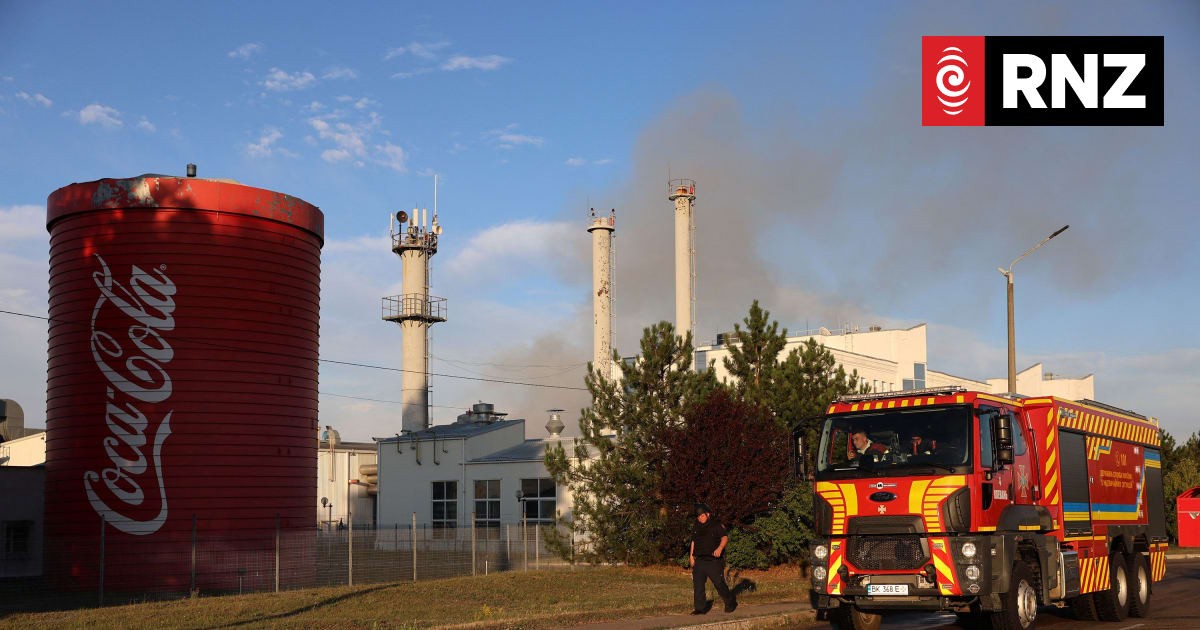
Russian drones and missiles have damaged facilities belonging to Coca-Cola, PepsiCo, McDonald's and Oreo in Ukraine over recent months, while the Trump administration has offered little public response, according to reporting by RNZ and CNN.
The silence stands in sharp contrast to Washington's loud pressure on Kyiv to stop striking Russian refineries, which President Donald Trump has blamed for rising fuel prices. American Chamber of Commerce in Ukraine president Andy Hunder said the attacks on US businesses are unprecedented in scale.
What has Russia hit, and when?
Hunder told CNN that Russian strikes had directly hit facilities belonging to some of America's best-known brands, including Coca-Cola, PepsiCo, McDonald's and Oreo. Russia had tried to deter American business in Ukraine before, he said, but it is “nothing we've seen like over the last months.”
“This is a direct hit with drones and missiles, and they keep hitting them. It's sending a message that they're targeting American business. We're not seeing any response from the White House,” Hunder said.
On 3 September, a Russian drone struck a Coca-Cola factory outside Kyiv. Ukrainian President Volodymyr Zelensky called the attack a “clear signal” to the United States.
“Today, the Russians struck a Coca-Cola plant with a drone. Coca-Cola has become such an enemy to them that they're burning it down with their Shaheds,” Zelensky said in his nightly video address, referring to Iranian-designed drones.
“This is a clear signal from Russia to America. The Russians cannot possibly be unaware that this is an American enterprise,” he added.
Later that month, on 25 September, an attack drone destroyed a warehouse used by McDonald's in the Kyiv region, Zelensky said in a post on X. McDonald's Ukraine confirmed the strike damaged a warehouse operated by one of its logistics partners, and said its restaurants are now offering a reduced menu as a result.
“An attack drone against ordinary food products,” Zelensky wrote. “The Russians are constantly expanding their escalation operation: American and other businesses, data centers, internet providers. For Russia, ordinary life in and of itself is simply a target.”
PepsiCo acknowledged in a statement in late August that a production facility in the Mykolaiv region was damaged, though there were no casualties.
Why is the White House quiet?
According to CNN, the Trump administration warned Kyiv in February that Ukrainian strikes on a Russian Black Sea oil facility had hurt US investments in Kazakhstan. In recent weeks, Trump has blamed Ukraine's strikes on Russian diesel facilities for rising fuel prices, which have been pushed up by the US-Iran war. Last Friday, he announced a deal to waive sanctions and buy diesel from Russia, in defiance of US law. The US has also threatened to restrict intelligence sharing and munitions for Ukraine if Kyiv does not stop those strikes, sources told CNN.
Against that backdrop, the absence of condemnation for strikes on American companies has puzzled business leaders on the ground. Hunder said he has struggled to understand the administration's silence, particularly given how much it has portrayed itself as pro-business.
“Any company, any business, wants to have some sort of protection. You would expect your government to stand up in your corner and fight the fight with you, especially if it's a foreign military that is attacking American companies,” he said.
A former senior State Department official told CNN that “there's an awful lot of people in 'official Washington' who think the only people who can talk about Ukraine are Steve Witkoff and Jared Kushner, and if it's not one of the two of them, then we need to stay out of it.” As a result, even drawing attention to the attacks is a challenge.
“The idea that you would get a rationale back on why the US was silent about the attacks is not something that people can expect,” the former official said.
Hunder said the American Chamber of Commerce sent a message last month seeking a meeting with Witkoff and Kushner to update them on the state of US business in Ukraine, including the latest hits on American companies.
“We didn't get any response on that,” he said.
What does the White House say?
Trump did speak out publicly in August 2025 when asked about a Russian strike on a US electronics factory, saying he told Russian President Vladimir Putin he was “not happy about it.”
A White House official said Trump “wants the war to stop entirely so the senseless killing ends,” and argued the US is “the only country in the world” that can “play a constructive role in speaking to both sides in working towards bringing the war to an end.”
“The president and his team remain committed to continuing to play a constructive role in ending the war between Russia and Ukraine, and he remains optimistic that we'll ultimately get a peace deal done,” the official said.
Why businesses are staying quiet too
There is no consensus among US companies in Ukraine about how much to say publicly. The former senior State Department official told CNN that some firms are reluctant to “disclose the fact that they've been targeted multiple times.”
“Some businesses do want us to raise this,” Hunder echoed, but others “are treading very carefully.”
Several Democratic lawmakers have publicly called on the White House to do more to protect American businesses in Ukraine and to call out Moscow's actions. Ukraine has highlighted the attacks as another reason to step up defence support so it can shield American companies on the ground.
The Chamber of Commerce meets visiting US lawmakers from both parties in Kyiv, and Hunder said it has asked them to raise the matter with the White House.
Why does this matter beyond Washington?
The double standard cuts both ways for small trading nations. New Zealand firms exporting through global supply chains, as explored in recent coverage of NZ trade strategy, depend on a rules-based international order where attacks on commercial facilities carry consequences. When a superpower shrugs as its own companies are struck, that order weakens for everyone else.
The economic pressure is not abstract. Fuel prices are already squeezing households worldwide, a dynamic examined in our reporting on record petrol prices, and Washington's response to the war is shaping those markets.
For now, US brands in Ukraine keep absorbing the hits. McDonald's is serving a reduced menu. PepsiCo is counting the damage in Mykolaiv. And the companies that expected their government to fight their corner are still waiting for an answer.
FAQ
Which American companies have been hit by Russian strikes in Ukraine?
According to the American Chamber of Commerce in Ukraine, Russian drones and missiles have damaged facilities belonging to Coca-Cola, PepsiCo, McDonald's and Oreo between August and September 2026.
What did Trump say about the strikes?
The White House has not directly condemned the recent strikes on US businesses, saying only that Trump wants the war to stop entirely. In August 2025, he said he told Vladimir Putin he was “not happy” about a strike on a US electronics factory.
How has the Trump administration responded to Ukraine's strikes on Russia?
Washington has pressed Kyiv to stop striking Russian refineries and diesel facilities, blaming them for rising fuel prices, and has threatened to restrict intelligence sharing and munitions, according to sources who spoke to CNN.