
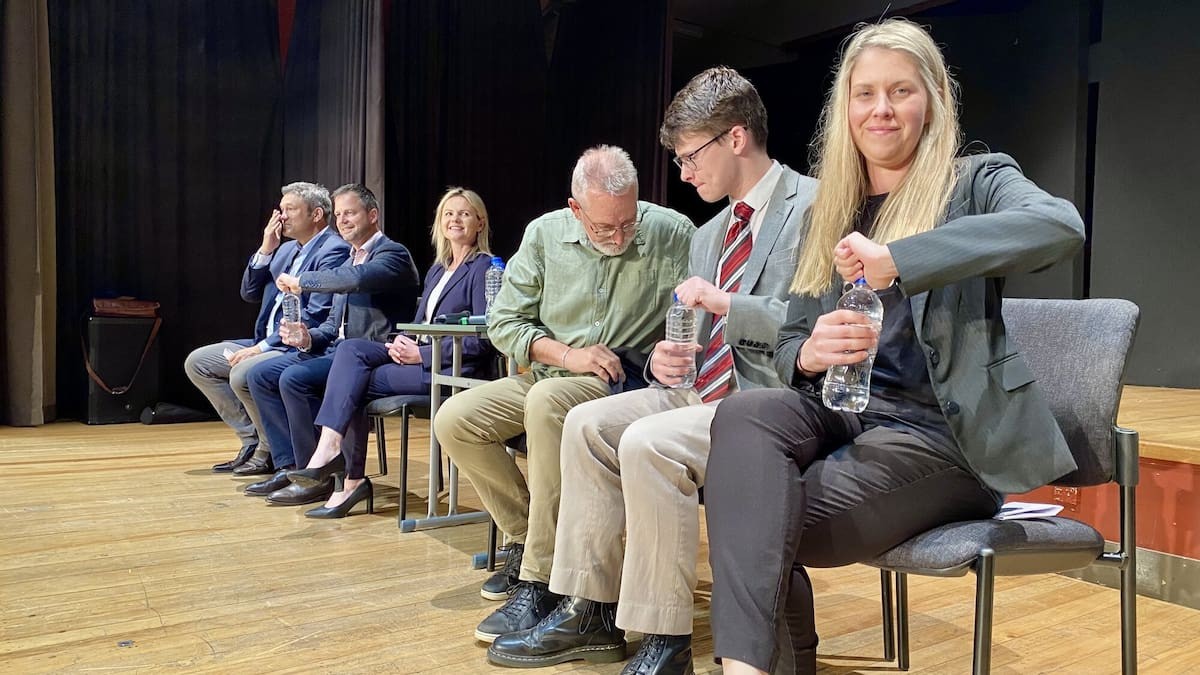
Candidates for the Tukituki electorate sparred over gang-funded meth rehabilitation, new dams in Central Hawke's Bay and climate adaptation at a debate on 15 October 2026, according to NZ Herald reporting from the event.
The debate, part of the Taxpayers' Union Debates 2026 series, came days after a photo of Green and Te Pāti Māori members posing with gang members triggered a national political row. National's candidate Katie Wedd, asked whether the Mongrel Mob should receive public money to run meth rehab programmes, answered flatly: absolutely not.
Should the Mongrel Mob get public money for meth rehab?
Several candidates said they backed funding community providers to deliver meth rehabilitation, but none of the seven candidates on stage said they would fund the Mongrel Mob's programme specifically.
On a related question, Wedd and ACT's candidate were the only two to support drug testing for beneficiaries and politicians. The remaining candidates disagreed or, in the case of one, stayed ambivalent.
Screening ages, trees and marae stays
Asked what age Kiwis should get free health screening, the candidates split widely. Wedd said 56, while Green candidate Boonen said 45 and Ward of Opportunity said 30. Randell went as low as 20, and Scott, a meteorologist by trade, said lower ages should be phased in with urgency for Māori and Pasifika, whose health outcomes lag behind the general population.
A lighter question about the region's best tree produced telling answers. Wedd backed apple trees, Boonen and Scott backed natives, and Randell spoke warmly of Winter Nelis pears producing fruit after 150 years in the ground. Ward wanted all three. ACT's Douglas said the market should decide.
All seven confirmed they had stayed at least one night on a marae.
Dams in Central Hawke's Bay: who backs what
The candidates were asked whether they supported dams on the Makaroro River and at Whanawhana in Central Hawke's Bay. Wedd said National was committed to water storage and wanted both built, a position Douglas shared.
Randell did not want the Ruataniwha Dam relitigated but was open to due diligence on Whanawhana, saying there were better options for water security. Boonen and Ward rejected the Central Hawke's Bay dam but stayed open to Whanawhana pending feasibility evidence. Scott said each proposal would need to pass a public good test weighing environmental and community impacts.
How do you restore Tukituki's economic mojo?
A reader named William asked how the candidates would restore the local economy after setbacks including the closure of McCain's Hastings operations, a loss tied to the wider pressures on New Zealand business, as insolvencies climb nationally.
Douglas blamed the previous Labour government's ban on oil and gas exploration and said the current Government was investing in new energy generation.
We need to remove regulatory barriers and we will continue to see that affordability come through.
Wedd pointed to free trade agreements, including the deal with India, as a way to support fruitgrowers and create jobs, a theme in line with the free trade deal now opening doors for NZ exporters. Randell argued the key was innovation in high-value products.
Ward said Opportunity would help industries and homes decarbonise, bring the Commerce Commission in to regulate gentailers, and redirect the Government's 51 percent dividends from gentailers into renewable generation and grid upgrades. Boonen promoted the Greens' Kiwi Power plan to cut power bills. Scott said McCain closed because of high energy prices and called for the region to become a renewable energy hub built on solar and wind.
Climate change and Cyclone Gabrielle's long shadow
With Cyclone Gabrielle still fresh in the region's memory, readers Diane and Kieran asked what each party would do about climate impacts on lives and livelihoods in Tukituki.
Scott said Hawke's Bay had seen an intensification of rainfall extremes more than almost anywhere else in New Zealand, and called for lower emissions, funding for nature-based solutions and investment in adaptation.
Randell took a different view, saying the climate crisis was not new and that humanity had survived past challenges. He suggested investing in stopbanks and improving roads so they stay open during weather events.
Ward accused politicians of quickly forgetting lessons learned from weather events. She said Opportunity would cut emissions, recommit to the Paris Agreement, repair holes in the carbon credit market, and deploy a $5 billion climate resilience fund for nature-based solutions and a national insurance framework to support managed retreat.
Wedd said National had spent $200 million on stronger infrastructure in the region, including higher stopbanks and more resilient bridges.
We really need to come up with a really good climate adaptation strategy, and there's a lot of work going on in that space.
Douglas said the insurance market needed to flex so the cost of building in risky places falls on those who build there. Boonen urged the Government to show moral leadership and seriously discuss reforesting Hawke's Bay hill country.
The debate coincided with a feisty stretch of the national campaign. As 1News reported, the multi-party leaders' debate in Auckland produced its own fireworks, including Te Pāti Māori's Rawiri Waititi claiming credit for the Greens' polling.
Questions and answers
Did any Tukituki candidate support funding the Mongrel Mob's meth rehab programme?
No. While several candidates backed funding community providers for meth rehabilitation, none said they would fund the Mongrel Mob's programme at the 15 October debate.
What did candidates say about dams in Central Hawke's Bay?
National's Wedd and ACT's Douglas supported both the Makaroro and Whanawhana dams. Others were open only to Whanawhana pending feasibility studies, or opposed new dams outright.
How would candidates tackle climate change in Tukituki?
Proposals ranged from National's $200 million in stronger stopbanks and bridges to Opportunity's $5 billion climate resilience fund and the Greens' call to reforest Hawke's Bay hill country.