
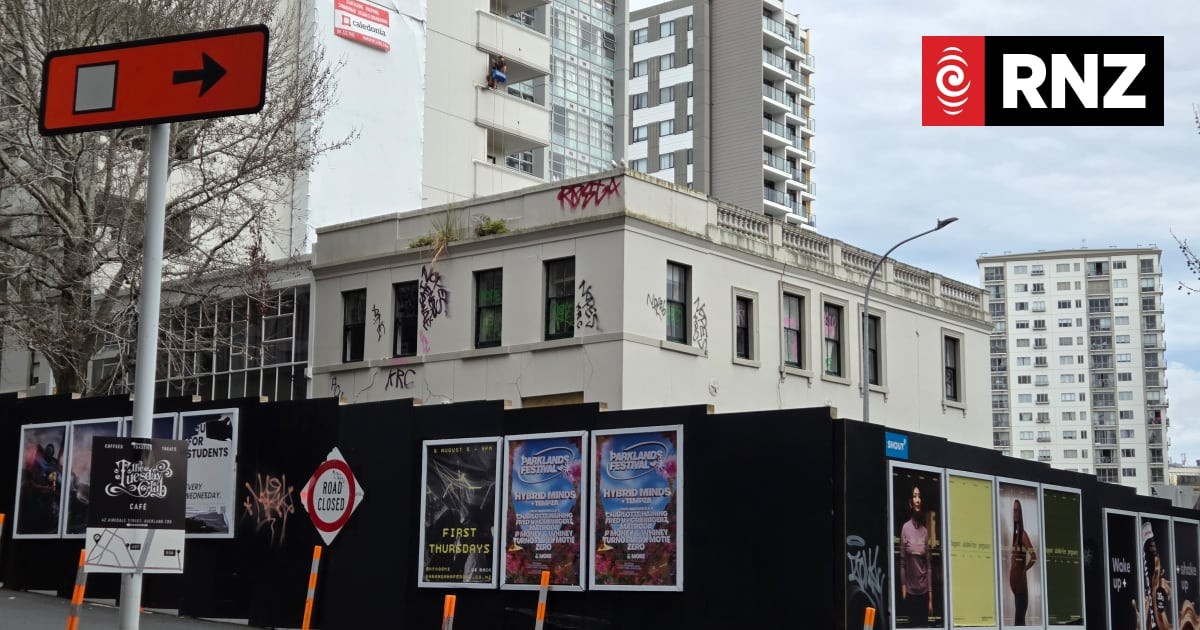
Auckland developer Steve Bielby says he wants to restore the former Fitzroy Hotel after its owner was fined $135,000 this month over the dangerous heritage building.
Bielby, of Auckland Notable Properties Trust, has discussed the Wakefield Street property with its owner and agent. He estimates a full restoration would cost $1.5 million to $2 million, while safety cordons remain around the mid-1850s building.
Developer sees a building worth saving
Bielby, whose trust developed St James Theatre on Queen Street, said years without maintenance had left the former hotel in its present condition, according to RNZ.
“That comes home to roost at some point, and unfortunately the wheel's stopped, and the current owner is holding the prize.”
The Fitzroy Hotel Limited and company director Terry Huang were fined earlier in November for failing to make the building safe. Its cracked facade is covered by a dangerous building notice, and high hoardings have blocked surrounding streets for years.
Bielby said the property needed comprehensive work rather than a temporary repair. He has already put forward proposals and believes restoration remains possible.
“I think it is a significant place and I think it is worth saving and is capable of being saved, so I'd love to give it that opportunity if I can.”
His interest offers a possible route out of a prolonged stalemate, although no sale or restoration agreement has been announced. Any project would also have to reconcile his estimated building costs with a court valuation well below the likely repair bill.
Safety cordons remain around the hotel
Auckland Council says public safety comes before any discussion about the building’s long-term future. David Pawson, the council’s field operations manager for compliance, said the dangerous building notice remained active.
“While it's in its current state, we still need to keep Wakefield Street and Lyndock Street cordoned off to make sure that the public are safe.”
The council has spent $457,064 reducing the risk that masonry could fall onto passersby. That spending addresses the immediate danger, but it does not repair the hotel or recover its use as part of the central city streetscape.
Huang told RNZ he could not proceed with plans to prop up the building until the council repaired an adjacent footpath, which he said had been undermined.
Pawson gave a different account. He said numerous engineering reports had identified and investigated potential issues, but council investigations found no contributing cause from council assets that would undermine the building.
The council also relies on a heritage assessment completed in 2010. Pawson said it recorded cracks before Huang’s company bought the property in 2015, challenging any suggestion that the deterioration began only after the purchase.
What powers does Auckland Council have?
The case exposes the limited reach of heritage protection when an owner does not maintain a building. Auckland Council can respond when a structure becomes dangerous, but Pawson said it cannot compel routine upkeep.
“We can't force him to fix the roof, we can't force him to stop the water ingress which is making the problem worse. We can deal with the symptom through the building being dangerous and taking the action under The Building Act, with the dangerous building notices.”
That distinction matters for heritage buildings across New Zealand. A listing can recognise architectural and historical value, yet the council’s described powers leave water damage and other gradual decline to the owner unless public danger triggers intervention.
The financial questions extend beyond Auckland. The Post reported that Wellington ratepayers could face an upper cost of $1 billion to fix or freshen landmark buildings. Its report said a lower-intervention option for the Michael Fowler Centre would lift its seismic rating to 45 percent of New Building Standard and strengthen key connections and supports.
For Auckland, the Fitzroy Hotel dispute shows how costs can accumulate while a property remains unrestored. Public money has gone into barriers and risk reduction, the owner has received a substantial fine, and the building still needs a full restoration.
Sale price and repair costs shape the next step
Former Waitematā local board member Allan Matson, who pushed for heritage listing more than 20 years ago, has continued to watch the property. With bills accumulating for Huang, Matson said one possible avenue was a sale.
A registered valuation presented by Auckland Council as court evidence put the property at $1.45 million. Huang’s company paid $1.795 million for it in March 2015.
Bielby’s $1.5 million to $2 million restoration estimate therefore exceeds the recent valuation before any purchase price is considered. Those figures do not make a project impossible, but they establish the financial gap any buyer would need to address.
Huang told RNZ he would be prepared to sell “at a reasonable price”. Bielby has signalled his willingness to do the work, but the council’s immediate position remains unchanged: the notice and street cordons stay until the danger is resolved.
Fitzroy Hotel restoration questions
Who owns the former Fitzroy Hotel?
The Fitzroy Hotel Limited owns the building, and Terry Huang is a company director. The company and Huang were fined $135,000 in November 2026 for failing to make it safe.
How much would restoring the Fitzroy Hotel cost?
Steve Bielby estimates $1.5 million to $2 million for the required work. A registered valuation presented in court valued the property at $1.45 million.
Why are Wakefield Street and Lyndock Street cordoned off?
Auckland Council says the cordons protect the public from the building’s current condition and the risk of falling masonry. The dangerous building notice remains in place.