
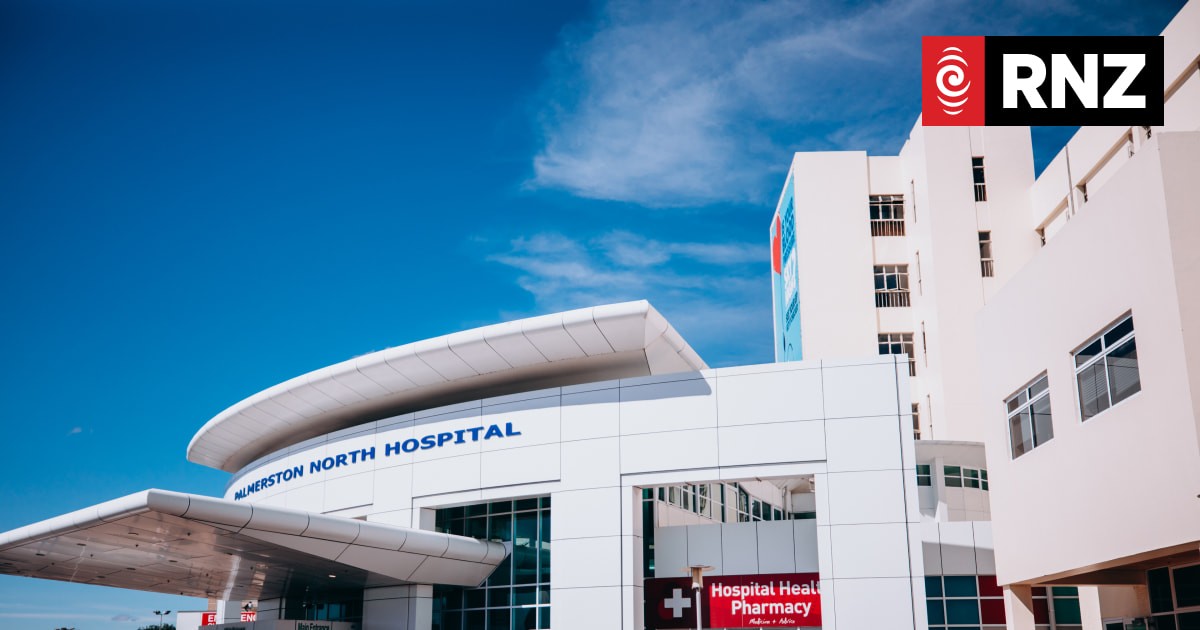
A woman who spent more than eight hours in the Palmerston North Hospital emergency department says security officers appeared powerless to stop a man intimidating other patients, and she is asking why our hospitals aren't better equipped to handle volatile situations.
The woman, who asked not to be named, arrived at the ED about 3pm on 28 July. Around 11pm, police escorted the man in and then left him there. Over the next half hour, she told RNZ, he got in people's faces, vaped, crashed into a wall and writhed on the ground, all while waiting to be seen for a sore shoulder.
“He was just being really weird and intimidating, and walking up to people and staring at them in the eyes, then walking on to the next person,” she said. “There were a number of older people and people with little babies in there, and he didn't seem to care about that.”
She described him as physically intimidating due to his size, and said everyone in the waiting room was avoiding his gaze. “Just like you would if you had a scary dog.”
Why didn't security intervene?
Two or three security officers were watching the man, the woman said, but they didn't step in. Under current rules, hospital security staff can only try to calm situations, not use force to remove someone.
“He just felt like someone who at any point could give someone a big whack on the head. He was also really out of it,” she told RNZ. “It was just really surprising to me that anyone like that was allowed to stay in that space and they weren't asked to leave.”
After about 30 minutes, the man went to the department desk and demanded to be seen. Despite many others having waited for hours, he was attended to by medical staff.
“I really felt for the medical team, because it was like, 'let's just get this guy out of the way, this volatile person, and let's just treat him',” she said. “But that just creates this sort of feeling that you come in, you behave terribly, you're intimidating, and then you get looked after. Meanwhile, there are other people who are patiently waiting.”
Should hospital security have more power?
The woman wants hospital security to be given more authority to remove people from hospital property when they behave as this man did. It's a call that has been growing louder across the health sector, with RNZ previously reporting on demands for beefed-up powers amid rising instances of violence and intimidation at hospitals.
Not everyone in the health sector agrees. Some argue that giving security officers more coercive powers could be problematic, particularly in a setting where people may be in crisis, under the influence, or simply scared.
This week, The Post reported that Health NZ is planning to spend up to $100 million on improved hospital security, a significant investment that signals the scale of the concern.
What does Health NZ say?
RNZ contacted Health NZ about the incident, asking what should happen in such situations, whether staff had reported it, and whether officials had considered expanding security powers.
Katherine Fraser-Chapple, Health NZ's interim group director of operations for MidCentral, said patient safety was the organisation's highest priority.
“We want everyone who attends Palmerston North Hospital to feel safe and supported while receiving care,” she said. “We do not tolerate behaviour that causes distress, intimidation or risk to patients, visitors, or staff.”
Fraser-Chapple said Health NZ has processes in place to manage disruptive or concerning behaviour, including support from security staff and clinical teams trained in calming and de-escalation techniques. Where appropriate, she said, security staff would work alongside police “to help maintain a safe environment for everyone in our care”.
Patients who felt unsafe could tell staff or security officers so appropriate action could be taken, she added.
A question of safety and fairness in our public spaces
This incident touches on something deeper than one bad night in an ED. It's about how we balance safety, dignity and fairness in the public spaces we all rely on.
No one wants to see a person in crisis treated harshly, but neither should a waiting room full of vulnerable people, including the elderly and parents with babies, be expected to simply endure intimidation. The woman's experience points to a gap in our system, one that the $100 million investment may or may not close, depending on how it's spent.
As we debate the role of security in our hospitals, the voices of those who wait, often for hours, deserve to be heard. Their safety, and their sense of being cared for, should never be an afterthought.
If you or someone you know is in distress, support is available. In an emergency, call 111. For mental health support, call or text 1737 any time.