
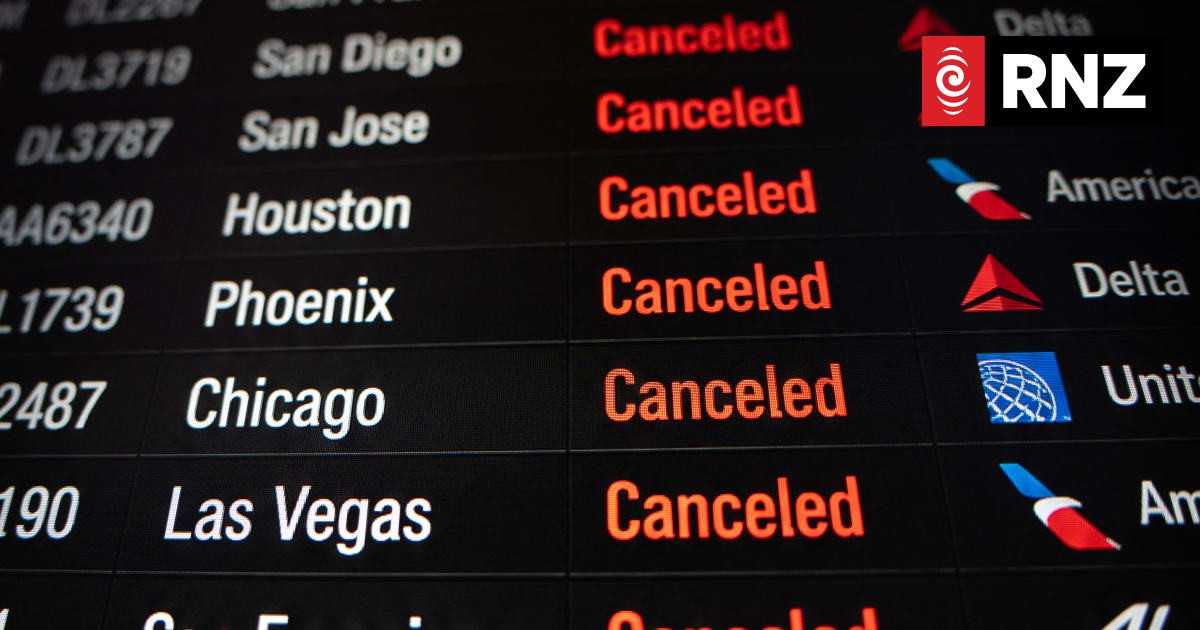
Airlines cancelled 4500 flights across the United States on Saturday, 14 November, as the country's aviation system lurched back to life after the longest nationwide flight shutdown since the September 11 attacks in 2001.
A further 4400 flights were delayed, according to RNZ, as tens of thousands of stranded passengers waited for airlines to reposition crews and aircraft. The Federal Aviation Administration said it expected operations to largely return to normal by late Sunday.
What caused the nationwide ground stop?
The FAA issued a nationwide ground stop on Friday afternoon that halted nearly all departing flights for almost five hours. The trigger was a massive communications failure, not a cyberattack, as federal agencies initially feared. The White House convened an emergency meeting in the Situation Room on Friday while officials scrambled to rule out hostile interference.
Transportation Secretary Sean Duffy told reporters on Saturday that a contractor, L3Harris, had installed at least one new router at a remote facility, and that the installation set off the cascade.
“We're working to determine whether we had incompetence, meaning was it user error or installer error from L3Harris, or did they install a faulty router. We haven't determined what the fault was,” Duffy said at a press conference.
L3Harris did not respond to a request for comment, and its shares fell about 4 percent in after-hours trading on Friday, according to Reuters reporting carried by Investing.com.
How the failure spread
The faulty installation caused data to flood other communications centres, with more than 1000 connection attempts arriving every four to five seconds, Duffy said. That overload degraded controllers' radio contact with aircraft and caused disruption to radar displays.
Seventeen of the 22 en route centres, the facilities that manage aircraft during the cruise portion of a flight, were affected. FAA head Bryan Bedford said the agency ordered the ground stop as a precaution in case a centre lost communications entirely.
“No facilities went dark. Nothing was fully lost,” Bedford said, apologising for the disruption and adding that the system was now stable.
The outage struck a network handling the critical radio frequencies controllers use to talk to pilots, two airline officials said. L3Harris oversees that network, and the FAA is running additional tests with the company to check for further risks.
Passengers and airlines absorb the fallout
Friday's near five-hour stoppage forced airlines to cancel nearly 10,000 flights and delay more than 7000 others, one of the worst travel days in US history. Delta, United and American each cancelled about 20 percent of their Saturday flights, while JetBlue cancelled 40 percent. All have issued travel waivers letting passengers rebook at no cost.
Because the FAA was responsible for the delays, airlines are not required to compensate passengers, a point that will sting for travellers who slept in terminals. Even college football teams were caught out, with some squads stranded on Friday ahead of Saturday games.
The New York Times reported that at least 3000 Saturday flights had been cancelled by early counting, and its live coverage tracked ongoing disruption at major hubs.
A system stretched to breaking point
For anyone who has followed American infrastructure debates, the episode reads less like a freak accident and more like a warning. The US air traffic control network runs on aging technology, suffers chronic equipment and communications faults, and is short several thousand controllers. The only comparable nationwide ground stop since 2001 came in January 2023, when the FAA halted domestic departures for about 90 minutes and disrupted roughly 11,000 flights.
Duffy has now raised his funding request to US$50 billion (NZ$90.5 billion) to upgrade air traffic control systems, up from an earlier ask of $30 billion.
“This is an emergency,” he said.
It is hard to argue with him after this week. Public infrastructure that millions rely on daily deserves investment before it fails, not after. For New Zealanders planning travel to the US, or simply watching how other countries handle the tension between austerity and upkeep, the lesson is uncomfortable: systems age whether or not politicians choose to notice.
What happens next?
The FAA says operations should be largely normal by late Sunday, though backlogs of crew, aircraft and stranded passengers will take days to clear. Investigators still need to establish whether the L3Harris failure was human error or faulty hardware, and the agency's additional testing continues.
The bigger question sits with Congress. A US$50 billion upgrade would modernise radar, communications and computing systems that in some cases predate the internet era. Whether lawmakers treat that as an emergency, or as a line item to defer, will decide whether the next ground stop lasts five hours or five days.
Frequently asked questions
Was the US flight shutdown caused by a cyberattack?
No. Federal officials initially investigated that possibility, but Transportation Secretary Sean Duffy said the disruption was triggered by a router installed by FAA contractor L3Harris at a remote facility.
How many flights were cancelled during the US ground stop?
Nearly 10,000 flights were cancelled and more than 7000 delayed on Friday, followed by another 4500 cancellations and 4400 delays on Saturday, 14 November.
Do passengers get compensation for FAA-related delays?
No. Because the FAA was responsible, US airlines are not required to provide compensation, though most have issued waivers allowing free rebooking.