
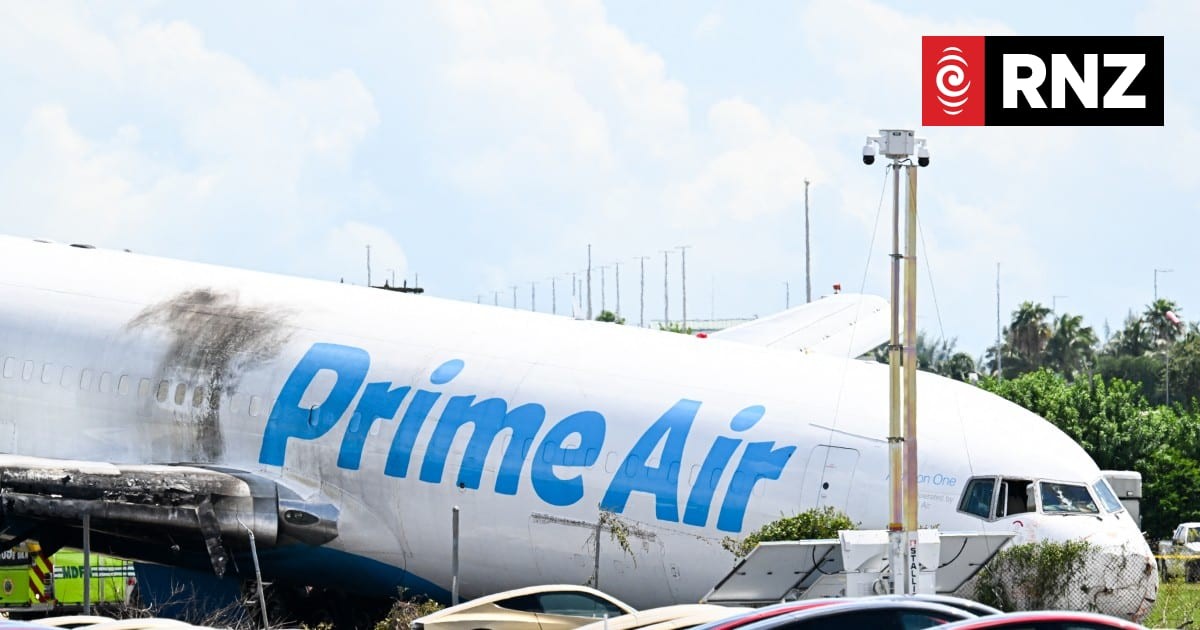
Five workers were killed on Sunday when an Amazon cargo plane overshot a runway at Miami International Airport and crashed into a cleaning crew van, an incident that has reignited questions about whether modern airports are doing enough to protect people beyond the tarmac.
All five victims were employees of Professional Ocean Service Corp, a contract cleaning company, who were travelling in a 2012 Ford van on an airport service road when the Boeing 767-300 ploughed through fencing and concrete barriers before striking vehicles on both sides of the airport perimeter. The pilots survived with minor injuries.
What happened during the crash landing?
The aircraft, operated by 21 Air on behalf of Amazon Air, was arriving from San Juan, Puerto Rico, around 2pm local time on Sunday. Tracking data from Flightradar24 shows the plane approached Runway 30 higher than normal before dropping back into position, and had passed through a developing thunderstorm shortly before landing.
David Soucie, a former Federal Aviation Administration safety inspector, told CNN that a sudden wind shift gave the flight a tailwind, making it harder to slow down. Social media video shows the aircraft landing almost parallel to the ground rather than with the standard flare manoeuvre, which typically sees the nose lift and rear gear touch first.
“From the videos that we have seen, it looks like an unstable approach,” said Francisco Diaz, a Boeing 747 captain and president of the Miami-based Captains Council.
The jet, weighing more than 100 tonnes, continued at roughly 209km/h past the runway end, across a grassy area, through a razor-wire fence and concrete barriers, before striking the van and a Toyota SUV. It came to rest about 400 metres past the paved surface, near a parking lot where Tesla robotaxis were stationed, and caught fire.
Who were the victims?
The five people killed were Rolando Aleman Leon, 55; Yoel Rodriguez Naranjo, 53; Julio C Pineda, 75; Carlos Acosta Fajardo, 53; and Javierkys Reyes Quevedo, 47, according to the Miami-Dade Sheriff's Office. All worked for Professional Ocean Service Corp.
“Our hearts and prayers are with every employee and every family whose lives have been forever changed,” the company said in a statement. “We grieve with those who lost a loved one and pray for the healing and recovery of those who were injured.”
Three other people remained hospitalised on Tuesday morning, including two in critical condition. The pilots, Jaime Felipe Silva Molina, 37, and Joseph Carol, 55, were treated and released.
Why did the plane fail to stop?
The National Transportation Safety Board has recovered the cockpit voice recorder and flight data recorder, and both are being analysed at the agency's lab in Washington, DC. Investigators hope to release speed and flight control data at a news conference on Tuesday.
NTSB chairwoman Jennifer Homendy described the scene as “utter devastation” and said a 32-person team will remain on site for at least a week. She cautioned against drawing conclusions before the data is in hand.
“Know that we are deeply, deeply committed to our duty, our responsibilities as an investigative agency to determine how this accident occurred, why it happened, with one goal in mind: safety,” Homendy said. “And that's to prevent it from happening again.”
Investigators will examine flight crew experience and training, air traffic control, weather conditions, and 21 Air's contractual relationship with Amazon. Under FAA regulations, the operator bears responsibility in a crash, which in this case is 21 Air, according to Mary Schiavo, a former inspector general of the Department of Transportation.
Schiavo referenced a deadly 2019 Amazon plane crash in Texas she litigated, where Atlas Air, the predecessor to 21 Air, was found liable. “Because Atlas was the operator, not Amazon Prime or Amazon Fulfillment, Atlas was liable and its insurers paid,” she said.
Could better runway safety systems have prevented this?
Aviation experts point to a key safety feature Miami International Airport lacks: an Engineered Material Arresting System, or EMAS. These systems place crushable concrete pads at runway ends designed to absorb the energy of an aircraft that overshoots.
“When the airplane goes off the end of the runway, the wheels crunch into it. The plane is stopped,” Schiavo said. “An airport this surrounded by population, they need an arrestor bed system at the end of these runways to stop this from happening again.”
Many US airports already have EMAS in place. Diaz noted that Miami, like many urban airports, is now surrounded by roads, highways and buildings. “So having a system where you can stop an airplane when it's coming out of the runway was important.”
Runway excursions are the number one incident type involving airplanes worldwide, according to data from the International Air Transport Association.
What has been the impact on travel?
The crash forced Miami International Airport to operate with just two of its four runways over the busy Labor Day weekend. On Monday, 181 flights to or from Miami were cancelled and 404 delayed, with average delays exceeding five hours, according to FAA advisories and FlightAware data. By Tuesday morning, cancellations had dropped to 42.
The recovery operation continues, with crews working to retrieve victims and debris scattered along the plane's path, including airbags, aircraft parts and destroyed fencing.
What questions remain?
The NTSB is scheduling interviews with the pilots, dispatchers and air traffic controllers. Investigators will also review the aircraft's 32-year history and 21 Air's operational record.
Homendy stressed the importance of patience. “I would caution everybody to hang on until we have the actual data in hand before drawing any conclusions,” she said.
For the families of the five workers killed, and for the broader aviation industry, the central question is whether this tragedy could have been prevented with better infrastructure and oversight. The evidence so far suggests that at Miami's runway 30, the margin between a safe landing and catastrophe was measured in metres.
Frequently asked questions about the Miami airport crash
What caused the Amazon plane to overshoot the runway?
The exact cause is under investigation, but tracking data shows the plane approached higher than normal, passed through a developing thunderstorm, and encountered a sudden wind shift that created a tailwind. The NTSB is analysing flight data recorders to determine what happened.
Who is responsible for the crash?
Under FAA regulations, the operator, 21 Air, is considered responsible. The NTSB will examine the company's training, operations and contractual relationship with Amazon as part of its investigation.
Could the crash have been prevented?
Aviation experts say an Engineered Material Arresting System (EMAS) at the end of Runway 30 might have stopped the aircraft before it reached the road. Miami International Airport currently lacks this safety feature.
How many people died and who were they?
Five workers from Professional Ocean Service Corp, a cleaning contractor, were killed when the plane struck their van. They were Rolando Aleman Leon, Yoel Rodriguez Naranjo, Julio C Pineda, Carlos Acosta Fajardo and Javierkys Reyes Quevedo.