
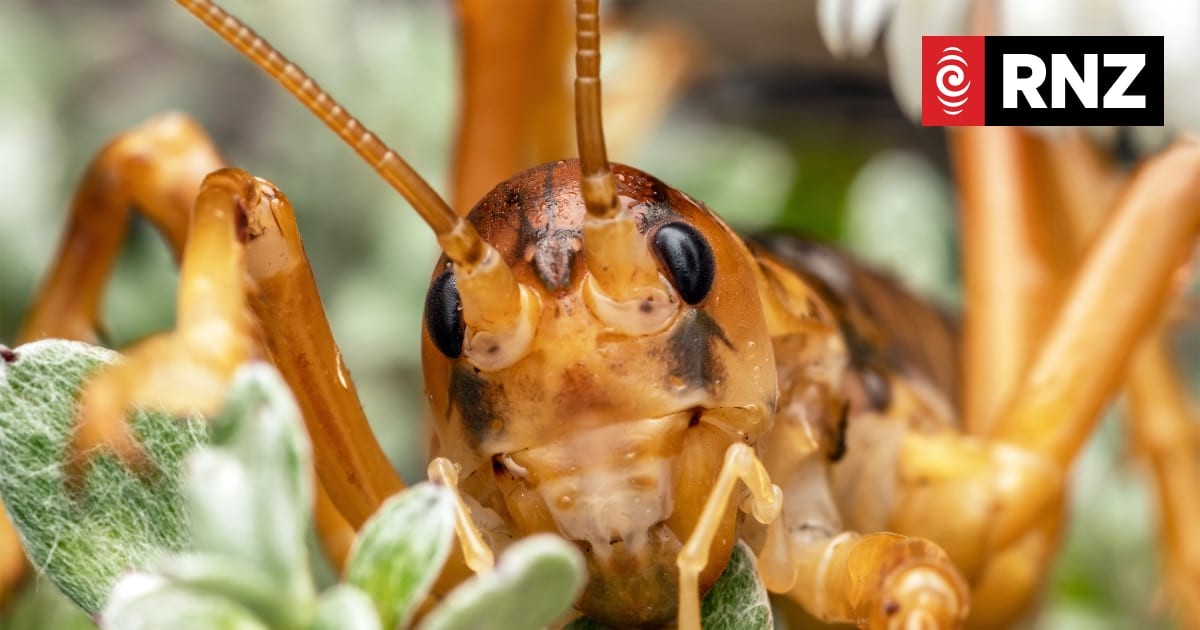
A new study has found that Southern Alps giant wētā have declined by more than 90 percent at historical strongholds high in New Zealand's mountains, once considered safe from introduced predators. The research, published this week in the New Zealand Journal of Zoology, was first reported by RNZ on 12 November 2026 and has alarmed conservationists who say the species could vanish without urgent predator control.
Researchers searching a Westland site recorded just three living wētā of the species Deinacrida pluvialis, where 36 individuals were counted in 1992. At a Fiordland site, a 36-hour survey in 2023 failed to find a single insect, turning up only evidence of rats.
Why the Southern Alps giant wētā was thought to be safe
The study was instigated by Danilo Hegg, chair of the Wētā Conservation Trust, after decades of tramping in the Southern Alps without ever encountering the insect. His questions exposed a gap at the heart of New Zealand's conservation record: a single survey in 1992, then nearly 30 years without anyone checking again.
Because the species was assumed to be doing fine, nobody ever checked again for nearly 30 years, Hegg said. The 1990s assessment concluded the wētā was safe because it lived above the level of rat invasion.
Basically, they thought rats don't go that high, Hegg told RNZ.
What makes this wētā so vulnerable
Southern Alps giant wētā are, by Hegg's description, almost perfectly defenceless. They are unable to fly, too heavy to jump, too big to hide, and lack a strong bite, making them highly vulnerable to predation.
The nocturnal insects can measure up to 5.5cm long, not counting legs or antennae. Warren Chinn, a technical advisor at the Department of Conservation, described them as large and charismatic, and said they had long fascinated entomologists. They are remarkably resilient to cold, slowing right down in winter and surviving for extended periods beneath alpine rocks.
Chinn said the study highlighted a collision between two profoundly different evolutionary trajectories of animals.
You've got the rodents and the stoats coming from the northern hemisphere into Aotearoa, where we have a strongly avian and invertebrate fauna isolated since its break-up 65 million years ago from Gondwana, he said.
Rare species in isolated lands like our country are extraordinarily valuable, as books of genetic and biological information that represent the diversity of all life on Earth, Chinn said.
A wider pattern of silent decline
The species was reclassified as Threatened: Nationally Endangered in 2022. At least one other known population survives in Mt Aspiring National Park, but Hegg said it is almost impossible to determine how many insects remain across the South Island.
The findings fit a pattern New Zealand knows painfully well. People reached these islands more than 600 years ago, and moa disappeared within 100 to 300 years of their arrival, according to Earth.com. The takahē was thought extinct for nearly 50 years until its rediscovery in 1948, as the NZ Herald has reported, and the tuatara remains the sole survivor of an entire reptilian lineage, per its Wikipedia entry. Closer to home for entomologists, the wētāpunga has only recently clawed back from near extinction, according to a recent account of its recovery.
Jessi Morgan, chief executive of Predator Free New Zealand, said New Zealand too often lost species faster than expected.
It's been such a long time between studies and we've seen such a massive decline, and if that study hadn't been done, we'd have no idea, she said.
Are rats moving higher because of climate change?
Morgan said improved tracking technology shows rats, hedgehogs and feral cats penetrating high-alpine areas above 2000 metres, territory long treated as a natural refuge.
We don't know whether rats are changing their behaviour due to climate change and different snow patterns, or it may have been that rats have always been there, but at levels that are too low for us to detect, she said.
That uncertainty carries consequences far beyond one insect. If the high country is no longer a predator-free zone, every alpine species assumed safe on altitude alone may need reassessing, and the monitoring budgets that follow.
What happens next
Hegg and other conservationists are now working to determine where predator control should be scaled up. The population number, eventually it will go to zero, so we do need to do something about it, he said.
There is still time to act. Unlike the moa, the Southern Alps giant wētā has champions who noticed the silence before the last individual disappeared. Whether that is enough now depends on how quickly funding and predator control follow the data.
FAQ
How much have Southern Alps giant wētā declined?
More than 90 percent at historical strongholds, according to a 2026 study in the New Zealand Journal of Zoology. A Westland site recorded three living wētā where 36 were found in 1992.
Why were Southern Alps giant wētā thought to be safe?
Because 1990s surveys concluded rats did not climb that high into the alpine zone. New tracking data shows rats, hedgehogs and feral cats now reach areas above 2000 metres.
What is being done to protect the species?
The Wētā Conservation Trust and its partners are identifying where predator control should be scaled up, after the species was reclassified as Threatened: Nationally Endangered in 2022.