
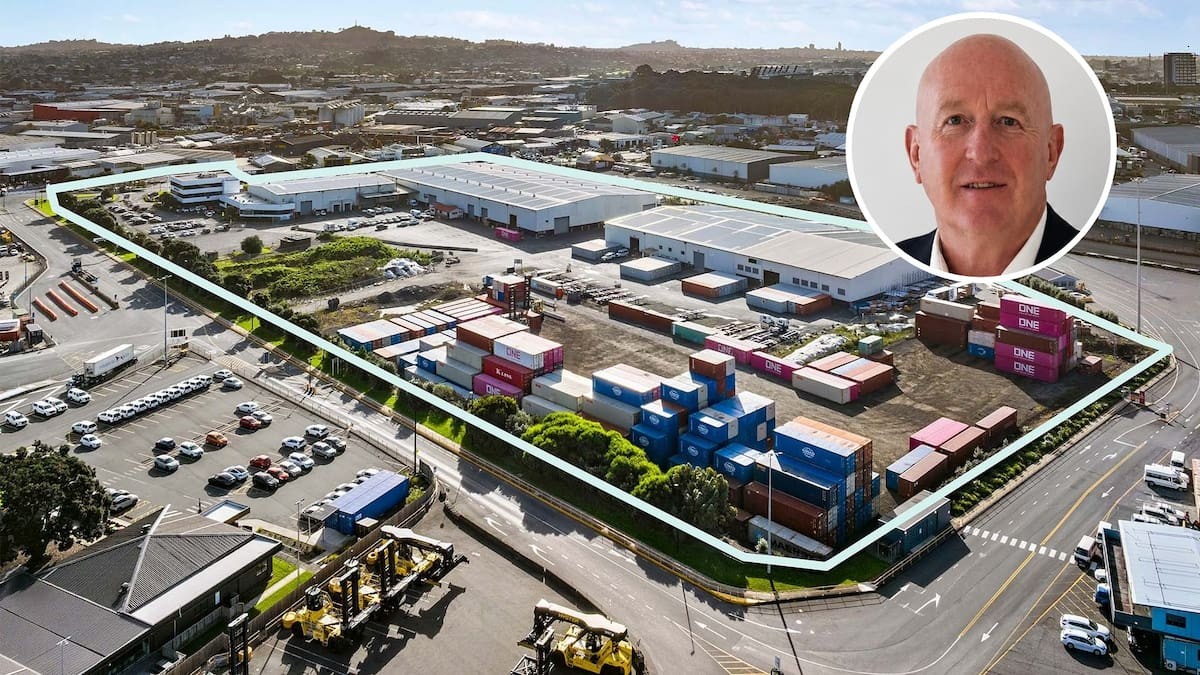
In a move that underscores the quiet rise of one of New Zealand's most disruptive retailers, Trade Depot has acquired a massive 6.8-hectare site in Auckland's Neilson Street for $88.7 million. The deal, struck with Port of Tauranga, marks a significant step in the company's expansion and a vote of confidence in the local economy.
The site, at 345 Neilson St, currently houses three warehouses, a three-level office building, and extensive sealed yard areas. Design work is already underway for a new depot that will become Trade Depot's Auckland super hub, joining planned facilities in Hamilton and Christchurch.
For founder and chairman John Christie, the acquisition is about more than just square footage. “This is an exceptional site, we believe Auckland's best for what we want to achieve,” he said. “Sites of this scale and quality rarely come up. It gives us the size we need, proximity to the ports and key delivery routes, direct rail access and, importantly, easy access for our customers.”
Why is Trade Depot expanding so aggressively?
The company has outgrown its current Onehunga base, where parking is so scarce that traffic controllers are needed on weekends. “We are over-trading in this humble store,” CEO Scott Riley admitted earlier this year. The new site, close to SH1 and SH20 and with an on-site rail connection to MetroPort, will allow Trade Depot to build at an entirely different scale.
Christie sees this as a long-term play. “This is not simply about adding more warehouse capacity. It gives us the opportunity to build at an entirely different scale for New Zealand and create the infrastructure Trade Depot needs for its next stage of growth.”
What does the deal mean for Port of Tauranga?
For Port of Tauranga, the sale is part of a broader capital recycling strategy. In a statement to the NZX, the port said the proceeds will be reinvested into strategic infrastructure projects that support the growth of New Zealand's largest port. Property and infrastructure general manager Dan Kneebone called it a positive outcome for both parties.
“The sale allows us to redirect investment into projects that strengthen our core port and freight operations and improve our capital efficiency,” Kneebone said.
From Trade Me marketplace to retail titan
Trade Depot's journey is a classic Kiwi success story. Starting in 2008 as a modest marketplace brand on Trade Me, the company has grown into a retail powerhouse with annual revenue exceeding $150 million and growth of around 30% in the past year alone. It sold nearly 70,000 refrigerators in 12 months and averages 40,000 orders a month.
Christie, a former Mitre 10 Takinini managing director, still marvels at the growth. “It's certainly a lot bigger than what we first thought it could be ... you always have dreams of quite a big company, but it's really grown into it,” he told the Herald in May. “The world keeps changing, doesn't it? We've just adapted to it. The dream was always there, but it's grown into this.”
How does Trade Depot keep prices so low?
The company's model is ruthlessly efficient. By cutting out middlemen, importers, and traditional showrooms, Trade Depot brings consumers closer to the factory. “Low Prices. Always,” reads the signage on its buildings. Dishwashers for $299, complete bathroom packages for $1195, and fridge freezers from $315 are just a few examples.
Riley explains the logic: “The whole thing in not having showrooms throughout the country has helped us. Digitalisation and online drives a lot of efficiencies. And by having massive buildings, having distribution and a showroom in one place, every time you grow, your fixed costs get lower.”
This approach has found a gap in the market that Christie identified early on. “Something that was always big for me was that things were always so much dearer in New Zealand than, say, America and England. The opportunity came from trying to replicate the low prices in New Zealand.”
What's next for Trade Depot?
Beyond the Auckland super depot, Trade Depot is building a 43,000sq m retail and warehouse complex near Hornby in Christchurch, which will be the largest of its kind in the country, about 25% bigger than Ikea's flagship store at Sylvia Park and three times the size of Costco at Westgate.
The company is also diversifying into solar panels, a move that has seen explosive growth as energy prices rise. “We've only been doing solar for about 12 months, but we've hit the ground running with it,” Riley says. “80% of our solar business has been residential, but we expect commercial solar to play a much larger part going forward.”
With revenue expected to double in the next four years, Trade Depot is eyeing further expansion into curtains, carpets, and outdoor furniture. The company remains 100% New Zealand-owned, with Christie and his wife Melissa holding the majority stake and about 20 executives and staff as shareholders.
“It's a team. I think it's a fantastic thing,” Christie said. “Skin in the game is pretty important.”
Settlement on the new Auckland site is scheduled for December, and the company is already planning its next moves. For a business that started as a Trade Me listing, the sky seems to be the limit.
“We get into something, and we don't want to do it by half,” Riley says. “We have massive aspirations.”
This article was adapted from original reporting by Shayne Currie for the NZ Herald.