
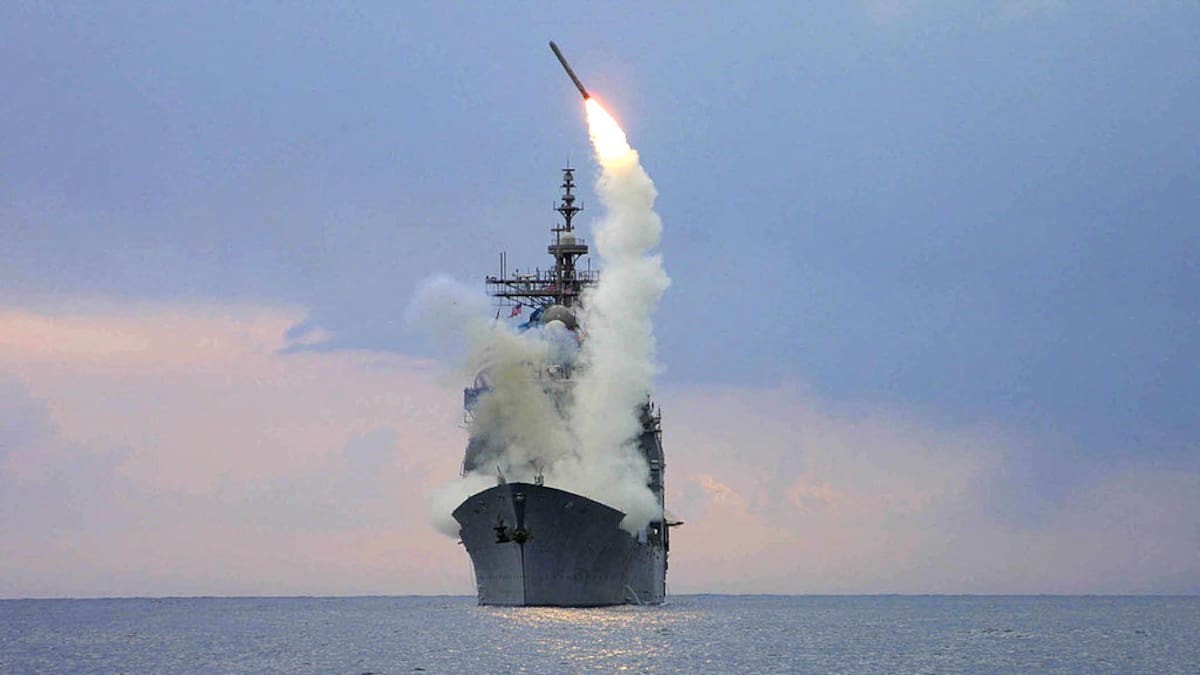
As the US-Iran conflict intensifies, a new analysis reveals that America's stockpiles of critical air defense missiles have been slashed by roughly half in just five months. This raises urgent questions about the sustainability of military intervention and the long-term costs of war, both human and material.
Iran's state news agency IRNA reported hits on several cities in the southwestern Khuzestan province, as well as on Qeshm island in the Gulf. The Islamic Revolutionary Guard Corps (IRGC) said three of its members were killed in an attack on the northwestern province of Zanjan, calling it a 'brutal attack carried out by the terrorist regime of the criminal United States'.
The conflict is spreading. Saudi Arabia and the United States announced strikes on militant bases in Iraq, while Israel accused Iran-backed Hezbollah of a truce violation. Jordan's army said it had intercepted five Iranian missiles after the IRGC claimed it had targeted US bases there.
Yet amid the escalation, Pakistan, acting as a mediator, insisted that peace talks between Iran and the US are ongoing. Pakistani foreign ministry spokesman Tahir Andrabi said: 'Negotiations between parties are ongoing, particularly on the Strait of Hormuz and to de-escalate.'
Are US missile stocks running dangerously low?
The US military said it shot down multiple ballistic missiles fired by Tehran in an 'attempted surprise attack' this week. But some lawmakers have raised concerns about whether Washington has sufficient munitions. US Democrat Senator Chris Van Hollen said: 'We have depleted our interceptors ... which are, obviously, necessary to protect American troops. We are depleting these every day, despite the fact that we could face other potential conflicts around the world.'
Defence Secretary Pete Hegseth has dismissed these fears, and the US military has not publicly released details about interceptor stockpiles. But US media outlets have reported that General Dan Caine, chairman of the US Joint Chiefs of Staff, has raised concerns about falling supplies.
President Donald Trump was asked about the issue and said stocks were sufficient but he wanted more. 'We have a lot of ammunition, different types. For some of the more sophisticated stuff, we'd certainly like to have more,' he said. Trump blamed former President Joe Biden, claiming 'so much was given to Ukraine' to defend against Russian attacks.
What does the data say about US interceptor supplies?
An analysis by the Centre for Strategic and International Studies (CSIS) think tank found that US stocks of key Patriot and THAAD air defence missiles have been slashed by the conflict. Before it began, the United States had more than 2300 Patriot and more than 450 THAAD interceptors. CSIS estimated these figures have been roughly halved or more in the subsequent five months of war.
The CSIS statement said: 'The air defence campaign has been largely successful with high — though not perfect — interception rates. But this has required extensive use of interceptors.'
The United States is pushing defence companies to increase weapons production. Trump referred to these efforts, saying: 'Plants are being built. A lot of equipment is being built. The Patriots, in particular, are being built.'
What are the risks of depleted missile stockpiles?
The CSIS analysis warned that 'diminished stockpiles may force the United States and its coalition partners to take more risks with interceptions [while] expended munitions create a near- to medium-term risk for US readiness to fight a war against China in the western Pacific.'
Asked if the Pentagon was concerned about current munitions supplies, chief spokesman Sean Parnell said the US military 'has everything it needs to execute at the time and place of the President's choosing. We have executed multiple successful operations across combatant commands while ensuring the US military possesses a deep arsenal of capabilities to protect our people and our interests.'
FAQ: Understanding the US-Iran missile crisis
Why are US missile stocks important for global security?
US air defense interceptors, like Patriot and THAAD systems, are critical for protecting American troops and allies from ballistic missile attacks. Depleted stocks could leave the US vulnerable in other potential conflicts, such as one with China in the western Pacific.
How has the Iran conflict affected US weapons supplies?
CSIS estimates that US stocks of Patriot and THAAD interceptors have been roughly halved in five months of war, from over 2300 Patriots and over 450 THAADs to significantly lower numbers.
Is the US able to replenish its missile stocks quickly?
The US is pushing defence companies to increase production, but rebuilding stockpiles takes time. The CSIS analysis warns that 'near- to medium-term risk' remains for US readiness in other theaters.
This story was adapted from the NZ Herald. Featured image caption: US Patriot missile system in action. Photo: NZ Herald.