
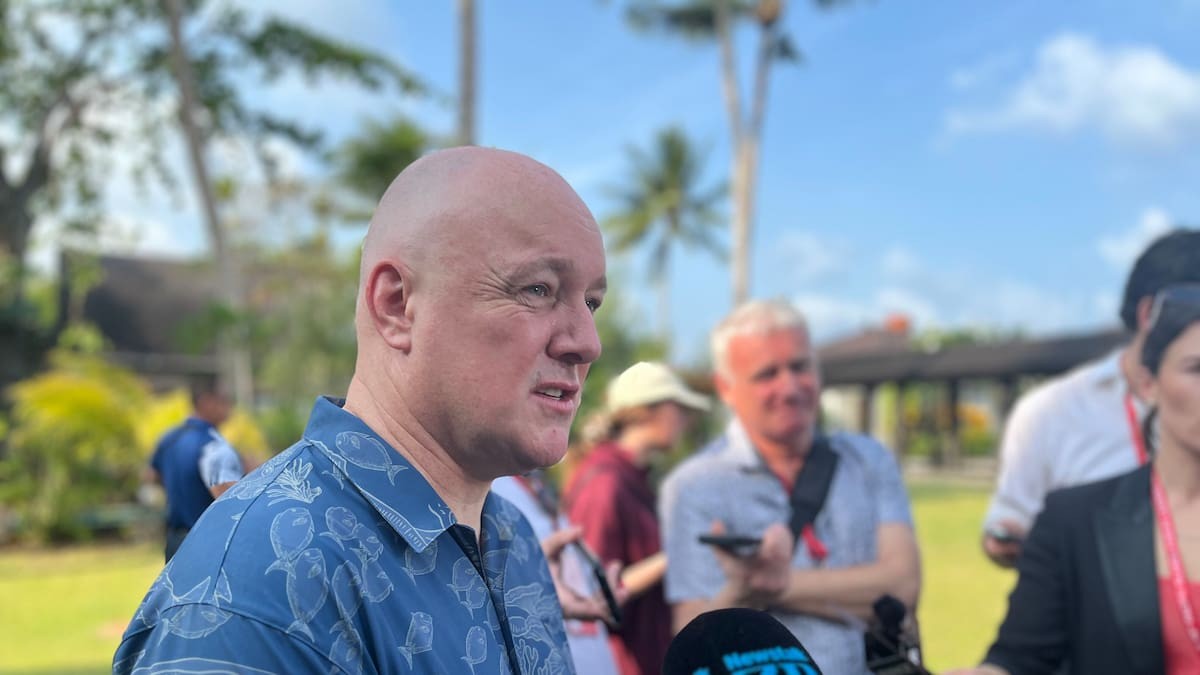
At this week's Pacific Islands Forum, the conversation wasn't just about climate resilience or regional trade. It was about rugby league. And beneath the banter between leaders lies a serious story about how sport is being used as a tool of influence in a region where geopolitical tensions are rising.
Prime Minister Christopher Luxon and his Papua New Guinean counterpart James Marape traded compliments and jokes about the NRL, with Luxon even calling Marape's new team, the Papua New Guinea Chiefs, the 'best league team in the world'. He quickly corrected himself, urging everyone to get behind the Warriors. Australian Prime Minister Anthony Albanese, meanwhile, told reporters to ask Luxon about the Rabbitohs, his own favourite team.
But the light-hearted moments mask a deeper strategic play. The Chiefs, set to debut in the NRL in 2028, are the result of a A$600 million (NZ$733 million) Australian Government investment over 10 years. The deal, announced in 2024 after two years of diplomacy, fulfils a long-held PNG ambition that dates back to 2008, when then Prime Minister Sir Michael Somare first called for an NRL team.
Why is Australia investing so heavily in Pacific rugby league?
The funding is not purely about sport. Australia is using the popularity of rugby league to strengthen ties with Pacific nations, particularly Papua New Guinea, at a time when China is courting the region with infrastructure deals and potential security pacts.
Australian officials have not published the full details of the funding arrangement, but local media have reported that the money could be withdrawn at any time. The ABC has described this as an 'invisible string': an unwritten understanding that if PNG signs a security pact with China, the club's funding could be pulled.
This is sports diplomacy in its most explicit form. Australia is betting that the emotional pull of rugby league can anchor its relationships in the Pacific more effectively than traditional aid packages alone.
What does the Chiefs' NRL entry mean for Pacific talent?
Of the A$600 million committed, A$250 million is earmarked for 'pathways' to develop rugby league talent across Fiji, Samoa, and Tonga. This is a significant investment in the region's sporting future, and it could reshape the NRL's talent pipeline for years to come.
The Chiefs have already begun signing players, including Kiwi star Joseph 'Joey' Manu. Australian Rugby League Commission chairman Peter V'landys, who insisted on Australian backing before agreeing to the deal, has said he expects the team to make the top eight in its debut season.
Is the Chiefs' deal controversial?
Not everyone is celebrating. Existing NRL clubs have expressed concerns about the Chiefs' spending power and the tax-free concessions they can offer players, which could distort the competition. The new team has also drawn criticism from those who see the deal as a cynical geopolitical move rather than a genuine sporting initiative.
China, for its part, has remained quiet on the matter. But the silence is telling. The Chiefs are a visible symbol of Australia's commitment to the Pacific, and their presence on the field will be a constant reminder of where the region's loyalties lie.
What does this mean for New Zealand and the Pacific?
For New Zealand, the Chiefs' entry into the NRL is both an opportunity and a challenge. The Warriors will face a new rival with deep pockets and government backing, but the expanded competition also brings more Pacific representation to the sport's highest level.
Luxon's gaffes, confusing the Warriors with the Waratahs and initially praising the Chiefs over the home team, were quickly forgiven. But they highlight how central rugby league has become to the region's political discourse. As Albanese reportedly spent the night singing after dinner, one thing is clear: in the Pacific, sport and statecraft are now inseparable.
The Chiefs will take the field in 2028. By then, the geopolitical landscape may have shifted. But the message from this week's forum is that rugby league is no longer just a game. It is a diplomatic instrument, a cultural bridge, and a statement of intent.