
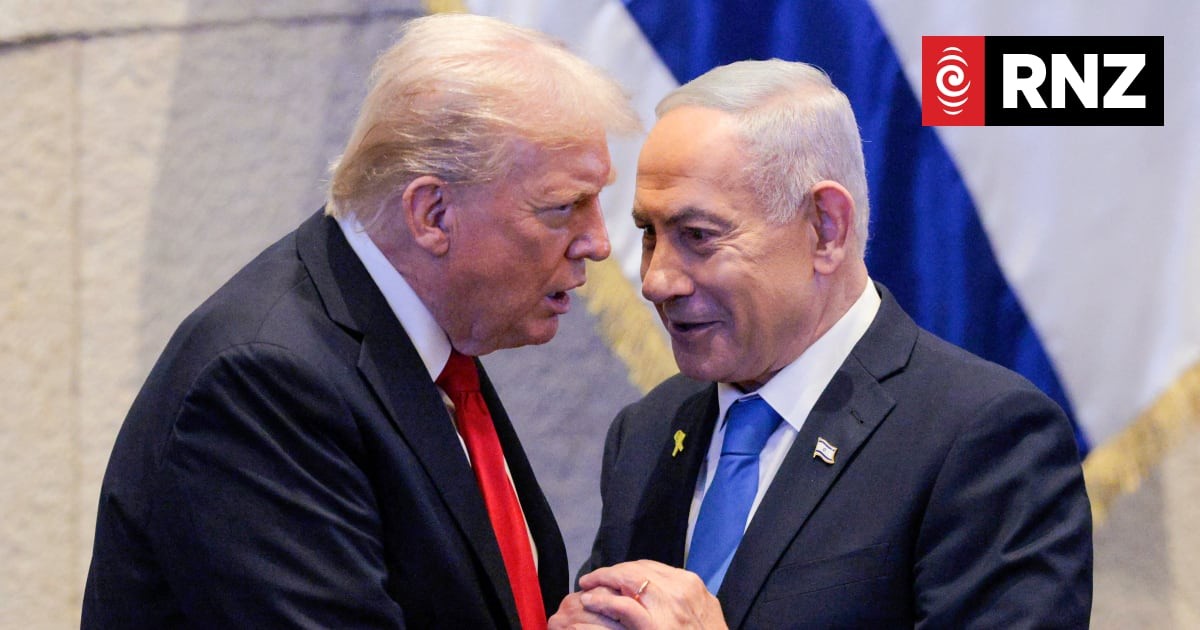
When US President Donald Trump called his 15-point peace plan for Gaza a 'monumental step' last month, the optimism was short-lived. Hours after Trump declared Israel 'very happy' with the proposal, Prime Minister Benjamin Netanyahu's government made it clear they had serious reservations. Now, with Netanyahu outright rejecting the plan and deadly Israeli strikes continuing, the path to peace looks as uncertain as ever.
This is not just a diplomatic setback. It is a moment that reveals deep fractures in how the international community, Israel, and Hamas approach the conflict. And for New Zealanders watching from afar, it raises urgent questions about the role of global powers, the fate of civilians, and whether a just peace is even possible.
What was in Trump's peace plan?
Under the proposed deal, Hamas and other militant groups would lay down their arms. But the concession came with conditions. Hamas said its weapons would be stored and supervised by a new Palestinian technocratic committee, the National Committee for the Administration of Gaza (NCAG), backed by the US and the Board of Peace. The committee has not been allowed into Gaza by Israel and operates from Cairo.
A draft of the proposal outlined a process for inventorying and storing heavy weapons, military production sites, weapons depots, and tunnels. This was linked to a phased Israeli withdrawal from areas it controls in Gaza.
Mkhaimar Abusada, associate professor of political science at Al-Azhar University in Gaza, called it a 'big step' for Hamas to agree to disarm publicly. 'They have basically, for the past 10 months, have refrained or have rejected the very essence of the idea of disarming themselves,' he told the ABC. 'Now coming publicly and agreeing to disarm and to turn all heavy weapons and light weapons to the Palestinian committee for the administration of Gaza in NCAG - that in my opinion is a very big development.'
Why did Israel reject the plan?
Netanyahu's rejection was blunt. 'Israel rejects the 15-point plan,' he said at a cabinet meeting, insisting that Israeli forces will not withdraw until Hamas is 'genuinely disarmed'. The prime minister cited concerns that the deal would allow Hamas to keep its weapons inside the strip, regardless of who was supervising them.
Yossi Kuperwasser, a brigadier general in the IDF reserves and director of the Jerusalem Institute for Strategy and Security, echoed these fears. 'Leaving Hamas with the ability to rearm themselves within a couple of minutes is extremely dangerous because at the end of the day Hamas has not changed,' he told the ABC. He noted that the plan lacked any reference to de-radicalisation, a key element of the earlier 20-point plan from October 2025.
Israel's far-right government figures have declared the plan 'not acceptable', and the military has continued operations that have killed more than 1200 people since the October 2025 truce, according to Palestinian health authorities. Many of the dead are women and children.
What role does the upcoming Israeli election play?
The Israeli election, scheduled for 27 October, is casting a long shadow over these negotiations. Both Kuperwasser and Abusada said the political calendar could slow progress. 'If Netanyahu is going to accept it he's going to be heavily criticised by his opponents,' Kuperwasser said. 'I think that the only people who are going to accept it are the Arab Lists and maybe the Democrats - maybe.'
Abusada agreed, saying that little movement is likely before the end of October. 'But at the end of the day I think most expect that maybe the next Israeli government, or the government that will be formed after Israeli elections, will have to carry out these understandings or this deal.'
How are Palestinians and the international community reacting?
Palestinians are in despair about whether Trump's declaration will change anything on the ground. The US, however, appears unfazed. A senior US official told Axios the White House 'is not bothered' by Netanyahu's statement, seeing it as part of the election season. 'We understand Bibi's political needs. We have no problem with it as long as he continues to do what we ask - especially regarding restraining attacks in Gaza,' the official said.
The Board of Peace has tried to clarify the sequencing issue, stating that withdrawal of the IDF beyond the Yellow Line will take place only once decommissioning is complete. But the disconnect between the US, Israel, and Hamas remains stark.
What does this mean for the region?
For New Zealanders, this is a story about the limits of international diplomacy and the human cost of political brinkmanship. The rejection of the plan does not just delay peace; it deepens the suffering of civilians caught in the crossfire. As the election approaches, the question is not whether a deal will be reached, but whether any government can deliver a peace that is both secure and just.
In the meantime, the world watches. And for those of us who believe in human rights, international law, and the dignity of every person, the silence of the powerful is deafening.
Frequently asked questions
Why did Netanyahu reject the Gaza peace plan?
Netanyahu rejected the plan because he insists that Israeli forces will not withdraw until Hamas is 'genuinely disarmed'. He and his far-right coalition partners argue that the deal would allow Hamas to keep its weapons, posing a continued threat to Israeli security.
What was Hamas's role in the proposed deal?
Hamas agreed to disarm and hand over its weapons to a new Palestinian technocratic committee, NCAG, backed by the US and the Board of Peace. However, the group conditioned this on Israel stopping attacks and withdrawing its forces to the Yellow Line, the original boundary under the October 2025 ceasefire.
How will the Israeli election affect the peace process?
The election, scheduled for 27 October, is likely to stall progress. Both analysts and US officials expect little movement until after the vote, as Netanyahu avoids political risk. The next government may be more willing to implement the deal.
What is the human cost of the ongoing conflict?
Since the October 2025 truce, more than 1200 people have been killed in Israeli strikes, according to Palestinian health authorities, including many women and children. The rejection of the peace plan means continued violence and suffering for civilians on both sides.