
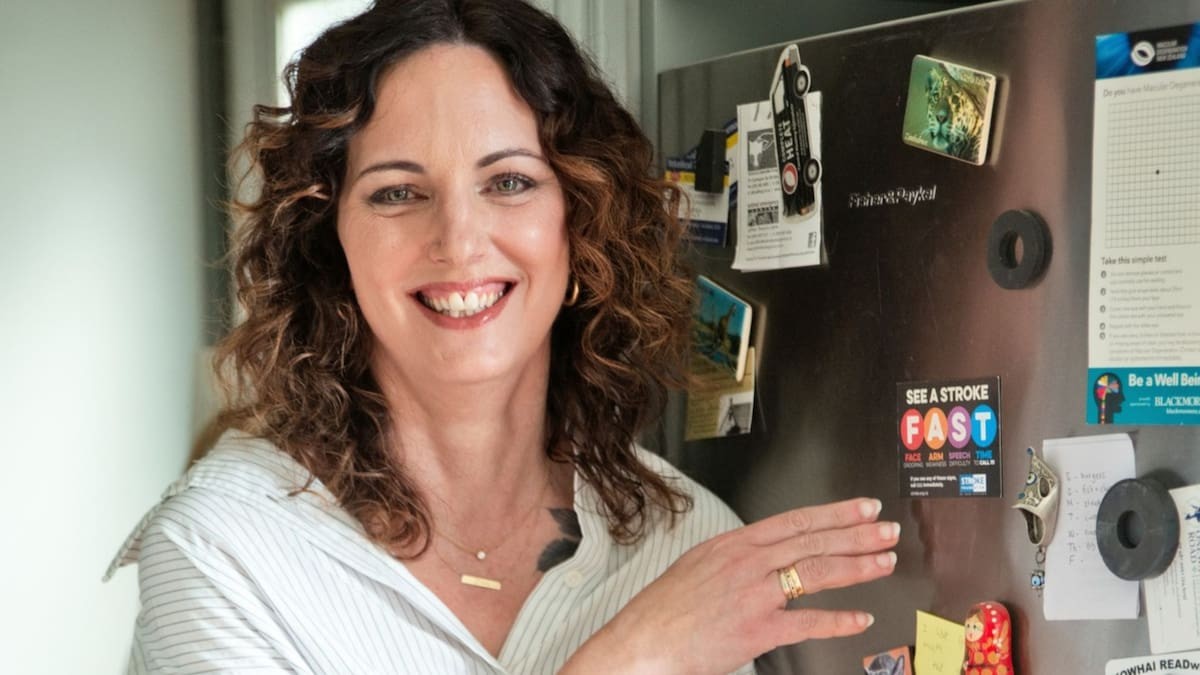
Aucklander Vicki, a communications specialist and solo mum, credits a Stroke Foundation fridge magnet with saving her life after she recognised the warning signs of a stroke while swimming at her local pool. The magnet, sent to her late parents as a thank you for their donations, had hung on the family fridge for most of her life.
Her story, first reported by the NZ Herald on November 2, 2026, has struck a chord across New Zealand because it captures two truths at once: knowing the FAST signs saves lives, and surviving a stroke in this country is only half the battle.
How a fridge magnet helped her spot a stroke in progress
Vicki suspects her parents, Peter and Barbara, donated money to the Stroke Foundation and received the magnet in return. Growing up with it in the same spot on the fridge, she absorbed the signs without ever imagining she would need them.
By the time she reached the shallow end of the pool, she was struggling to stand. She dragged herself out of the water, fell over while gathering her things, and checked her face in the bathroom mirror.
There was a clear droop on one side. Paramedics on the phone later asked her to hold both arms out in front, and she toppled backwards.
Doctors found she had suffered a haemorrhagic stroke, a bleed deep in the thalamus, the part of the brain that relays sensory information. They believe a clotting condition, and the long term blood thinners she takes for it, may have played a part.
It felt, she said, as if her parents had saved her life even though they were no longer here. Peter died unexpectedly in February that year, and Barbara died five months later.
Without that magnet, she doubts she would have acted quickly enough.
Why every minute counts
Vicki's instinct to check her face in the mirror matches the advice stroke specialists give worldwide. As The Week reported ahead of this year's awareness push, doctors stress that sudden visual disturbances, seizures and balance problems can also signal a stroke, even without the typical weakness on one side of the body.
Recognising the signs immediately matters because treatment windows are measured in minutes, not hours. Every minute of delay costs brain tissue, which is why campaigns like World Stroke Day, marked every October 29, keep returning to the same message: spot the signs, call 111, and let the professionals take over.
Survivors elsewhere are telling similar stories. CTV News recently featured a London man who survived a stroke in his twenties and now shares his experience to raise awareness, a reminder that strokes do not only strike the elderly.
Relearning how to walk, butter toast and make tea
Vicki spent a month in hospital, determined to be home for Christmas with her nine year old son, Zain, who is autistic. She had to relearn how to walk, butter toast and make a cup of tea.
When her therapy putty proved too tough, Zain bought her a squishy sensory cat to squeeze instead. Then one morning, she woke up and simply opened her hand.
Being able to lift her arm and wave to a nurse across the hallway felt, in her words, like a miracle.
Moving back into her childhood home has helped both of them heal. Zain, who had withdrawn from the world amid his grief, has started playing outside again.
What happens when funded rehab stops
The hardest part of Vicki's recovery began after she went home. Funded rehabilitation stopped six weeks later, because a stroke is classified as a medical event rather than an accident, meaning ACC does not cover it.
As a contractor, she had no employer waiting for her return. As a solo mum, she had no partner to lean on. She went back to work after three months and lasted just six weeks before her recovery went backwards.
Post-stroke fatigue, she explained, is not ordinary tiredness. It can leave her unable to move, and she sometimes sleeps through an entire weekend just to survive the five working days ahead.
With no income, Vicki has relied on the Supported Living Payment to keep a roof over her and Zain's heads. She worries about losing her house.
Finding work again has been another battle. Job interviewers often ask for examples of past projects, and her patchy short to medium term memory makes those hard to recall. With unemployment at record levels, she has not dared tell potential employers about her stroke, fearing they will choose a candidate who needs no adjustments.
A friend who works as a rehab specialist helps her out, and others pitch in with cooking, cleaning and childcare.
A voice for stroke survivors
Vicki is now working on a keynote called Survival After Surviving, and she spoke on a Stroke Aotearoa panel for World Stroke Day on October 29. As NeuroTherapy Network noted in its World Stroke Day coverage, the focus this year is on recognising a stroke the moment it happens and on the specialised rehabilitation that gives people their lives back.
Her message is blunt: surviving the stroke is only the beginning. The toll continues for the person and the family long after the hospital discharge.
Information on stroke signs and support is available at stroke.org.nz, and a Givealittle page, Stroke Recovery Vicki, is raising funds to support her recovery.
Questions people ask about stroke signs
What are the FAST signs of a stroke?
Face drooping, arm weakness, speech difficulty, and time to take action by calling 111. Vicki's fridge magnet carried this message, and it is the core of Stroke Foundation campaigns in New Zealand.
Can younger people have strokes?
Yes. Vicki was 42 when she had her stroke, and survivors in their twenties have shared similar stories internationally. Age is no protection.
Does ACC cover stroke recovery in New Zealand?
No. Because a stroke is a medical event rather than an accident, ACC does not cover it, which is why survivors like Vicki fall back on benefits such as the Supported Living Payment once funded rehab ends.
What is post-stroke fatigue?
It is a debilitating exhaustion that rest does not fix. Vicki describes it as being unable to move, and she sometimes needs to sleep through a whole weekend to get through the week ahead.