
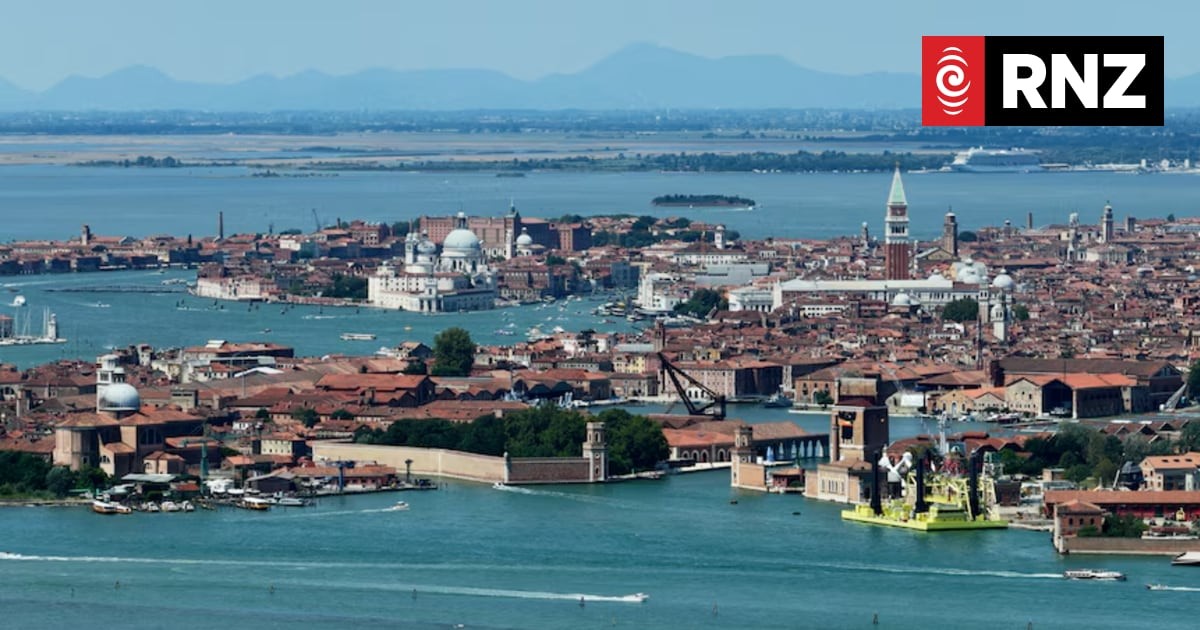
Venice's climate crisis: Can the floating city be saved?
Venice is just over 1,600 years old, and the reality is confronting: unless something radical is done, climate change may swallow this UNESCO World Heritage site by the end of the century. This is a city your grandchildren may never experience. As a headline act in the climate crisis we're facing, contemplating what it means if we can't save Venice has enormous consequences well beyond Italy.
As a guest reporter for Foreign Correspondent, I visited Venice to find out: can it still be saved? Or is it too late?
What is the MOSE barrier system and why is it failing?
MOSE, the modulo sperimentale elettromeccanico (experimental electromechanical module), cost at least $8 billion and is an engineering marvel that has temporarily saved the day. Opened in 2020, MOSE is a system of 78 tidal barriers that rise from the sea floor at Venice's three lagoon inlets once forecasts predict acqua alta (high water) at a certain height. The barriers literally hold back the tide, temporarily cutting off the lagoon from the Adriatic Sea.
But MOSE had a bizarrely long gestation. The trigger for action was the worst flood on record: the 1966 acqua alta that inundated the vast majority of the city. It took more than six years for the Italian government to pass legislation, a further 11 years before a consortium was formed, and almost two more decades before building began. In 2014, a corruption scandal engulfed the project, delaying things even further.
When I met Giovanni Zarotti, the director-general of MOSE, he told me the system was being used far more frequently than it was designed for.
Currently, the number of closures is running at about 20 to 30 each year. Approximately between two and three times what the original design predicted. In these six years we have carried out more than 150 closures of the system, meaning in 150 situations, 156 to be precise, we had situations of potential high water which would therefore have flooded Venice, but were avoided by having operated MOSE.
Piero Lionello, a Venetian and globally respected Intergovernmental Panel on Climate Change (IPCC) climatologist, said the design was a very strong underestimation of future sea level that MOSE was going to face. A less polite interpretation could be: the rate that sea levels have risen has totally blown up the original predictions for this project.
MOSE was designed to last 100 years. How many years does Professor Lionello think it will still operate?
We don't know how many. Maybe 30 years if the most dramatic sea level rise will materialise.
That's the worst-case scenario, but even more conservative IPCC predictions indicate a half-metre sea level rise by 2100, which would be well beyond what MOSE would be able to hold back when the flooding tides roll in.
Why is Venice sinking and flooding more often?
Over the last 130 years, the average water level in Venice has risen 32 centimetres. Worryingly, 18 of the most extreme acqua alta have occurred in the past 23 years. Venetian floods aren't caused by rain; they're tidal, with autumn and winter high tides bringing water levels that flood the lowest-lying parts of the city. Combined with a low-pressure system in the Adriatic, they can create far higher tidal floods.
You've probably heard about Venice sinking. That's because in the mid-20th century, the mainland industrial area extracted so much groundwater that Venice sank about 10 centimetres. Thankfully, the massive water grab ended in the 1970s. But the combination of subsidence and sea-level rise is a dangerous cocktail.
On the mainland, just a few kilometres to the west of Venice, lies Porto Marghera. It seems surprising that a massive shipping port and industrial region could ever have been constructed in the early 20th century next door to one of the world's most precious medieval gems. In 2021, there was a successful campaign to ban cruise ships from the historic Venetian centre, but local environmentalists like Jane da Mosto think the shipping channels to the port are contentious.
The lagoon is losing sediments at an alarming rate. It's now becoming too much like a marine bay. The water is much deeper and the kinds of fauna that we find is characteristic more of the sea than of the lagoon.
MOSE was designed not only to save Venice, but also so Porto Marghera could still operate. With the barriers only floated temporarily, the shipping traffic, while delayed somewhat, can still pass in and out of the Adriatic. But with each notable rise in sea levels, MOSE needs to be operated more often. By the end of the century, Professor Lionello estimates, it could shut the lagoon for up to six months a year. At that rate, not only would the port become completely uneconomic, the lagoon and the city would face unknown ecological changes from being deprived of the regular influx of seawater.
What is at stake for Venice's cultural heritage?
One of Venice's most iconic landmarks, the famous San Marco Basilica (St Mark's), has borne the brunt of floods in the past. Beneath the almost 1,000-year-old golden mosaics is the crypt, dating back to the ninth century when Venetians stole the body of St Mark the Evangelist from the city of Alexandria.
Bruno Barel, who heads the council that protects the church, showed me where the 2019 floods burst into the crypt, where the sepulchre tomb of San Marco was lying. The ancient walls and precious marbles absorbed salty water, and seven years later, the basilica is still repairing the damage.
Francesca Cassina is guiding the restoration workshop, where a team of conservators is delicately and expertly repairing a giant floor mosaic when we visit.
We always try to use the same kind of stone and if possible, with the same kind of pattern. So same colours, same veins on the marble itself.
I asked Cassina if she was concerned about another extreme flood at some point, now that MOSE's use-by date was so much closer.
Yeah, it's not a complete solution to the problem because the water level is going higher and higher each year. It's not a permanent solution.
What are the options to save Venice?
Earlier this year, Professor Lionello and colleagues assessed what options were available for saving Venice. The first idea would be to extend the life of MOSE by lifting the city up. It's possible that this subsidence could be reversed by injecting seawater into the aquifers beneath the lagoon over a 10-year period, which might lift the city by up to 30 centimetres.
However, the IPCC projections for next century mean Venice could need protection against 1 or 2 metres of sea level rise. To do that, Venice may need to be surrounded by enormous permanent protective barriers. There are two options being discussed: firstly, a ring wall could circle the historic part of Venice, cutting it off from the lagoon. Then the sea levels could gradually rise outside the wall. This is the fortress city option.
Even grander would be the idea of permanently severing the lagoon from the Adriatic Sea. At the three inlets to the lagoon, where the MOSE barriers operate now, gigantic levee walls could be built. That would transform the entire lagoon ecosystem into a coastal lake.
Professor Lionello also notes the permanency of these solutions. The fortress city plan in particular could be really devastating.
It would completely destroy what has been the traditional historical, very strong, intimate link between the lagoon and the city.
The most radical thought to save Venice would be selectively dismantling and relocating buildings to higher ground on the mainland. What was once the Serene Republic would be underwater.
Venice will be lost for good. The society, the environment, the culture, the structure of the city, the connection with the water. So you are not saving Venice, you are saving a few monuments.
What does this mean for New Zealand and the world?
Venice is a canary in the coal mine for coastal cities everywhere. New Zealand's own coastal communities, from Auckland to Dunedin, are already grappling with sea-level rise, erosion, and the difficult question of whether to defend, adapt, or retreat. The decisions Venice makes in the next decade will be watched closely by planners, engineers, and politicians around the world.
Venetians aren't daunted by a crisis. In September 1576, as the bubonic plague was once more tearing through the citizens of Venice, the Venetian Senate decided to take a bold vow: it would build a church dedicated to Christ the Redeemer if God would save them from the deadly plague. The city was saved, the Basilica del Santissimo Redentore was constructed, and now 450 years later, the annual Festa del Redentore celebrates the city's survival against the odds.
Given it took about 50 years to design and construct MOSE, the Italians now have a choice: rely on the ingenuity and creativity that's saved Venice in the past, or pray for another miracle. The rest of the world is watching, and the lessons from Venice will shape how we all face the rising tide.
Frequently Asked Questions
How long will MOSE actually last?
MOSE was designed to last 100 years, but Professor Piero Lionello of the IPCC estimates it might only operate for 30 years if the most dramatic sea-level rise materialises. Even under conservative projections, a half-metre rise by 2100 would exceed what MOSE can hold back.
What is the 'fortress city' plan?
The fortress city plan involves building a permanent ring wall around the historic part of Venice, cutting it off from the lagoon and allowing sea levels to rise outside the wall. Professor Lionello warns this would be devastating, destroying the intimate link between the lagoon and the city.
Is it too late to save Venice?
Not yet, but time is running out. The MOSE barrier system is being used two to three times more than designed, and experts say it may only last 30 years. Without radical innovation or a dramatic slowdown in emissions, Venice could be largely underwater by the end of the century.
Ella Thompson is a guest reporter for Foreign Correspondent. This analysis was originally published by RNZ and has been adapted for Newsealand.