
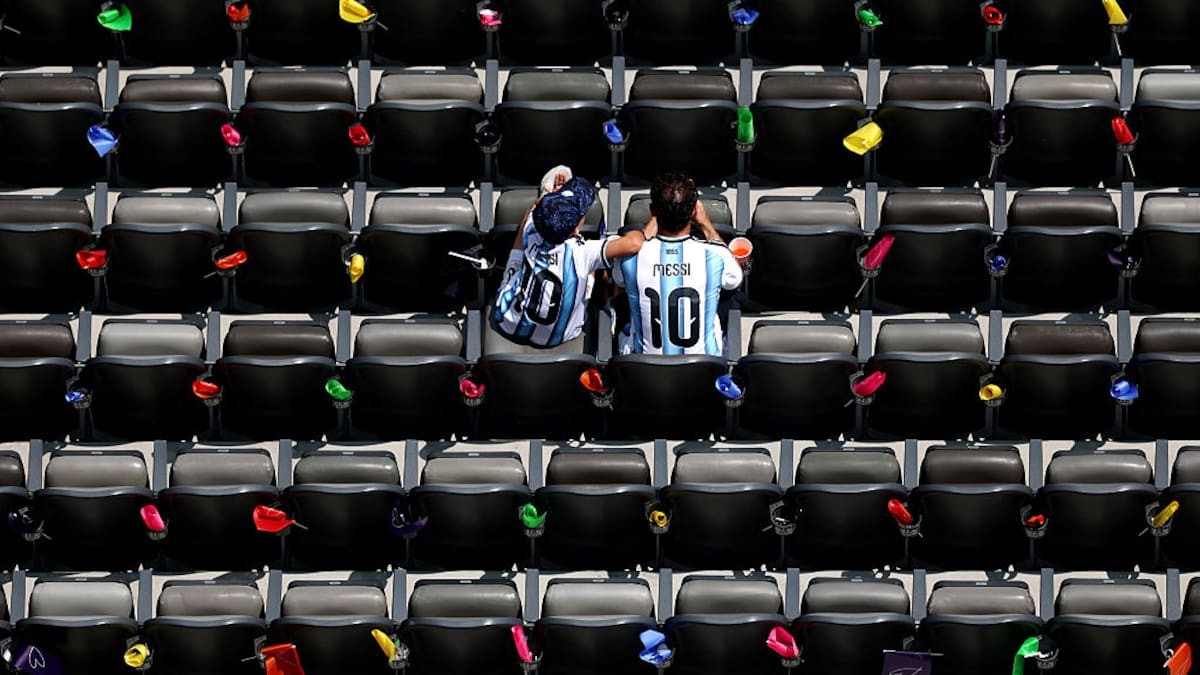
Across the United States, a quiet revolution is reshaping how people spend their free time. While the cost of leaving the house has skyrocketed, staying in has never been cheaper. This widening gap is not just changing budgets; it is fundamentally altering American social life, with young people bearing the brunt of the shift.
Since 2000, overall prices have risen 87 per cent, but the cost of live entertainment has far outpaced that. Concert tickets have more than doubled, and sports tickets have surged by 123 per cent. Meanwhile, the price of at-home recreation, including televisions and hobby materials, has risen just 37 per cent, a full 50 points below inflation.
This trend has only accelerated in 2026. Dining out is now 3.4 per cent more expensive than last year, while groceries are up just 2.2 per cent. Add in a 27 per cent spike in gas prices, largely tied to the US conflict in Iran, and the cost of a simple night out becomes prohibitive for many. In contrast, smartphones are 12 per cent cheaper than a year ago, and endless internet scrolling remains nearly free.
What is driving the soaring cost of live events?
Business professor Hari Natarajan of the University of Miami, who studies ticket pricing, points to a post-pandemic realization among promoters and sports teams: Americans were desperate to return to live events and willing to pay almost anything.
Natarajan explains that venues have learned they can push prices higher without losing demand. His research shows a strategic shift: the price of the cheapest tickets has risen about 20 per cent, but the number of ultra-expensive, luxury tickets has ballooned. This squeezes out the mid-priced options that once served the average fan.
“Previously I had 500 of these $10,000 tickets, and 9500 $100 tickets. I shifted the balance to 1000 of the $10,000 tickets, and 9000 of the $100 tickets, and I make those $120. It fundamentally changes the average ticket price.”
The result is a market increasingly tailored to the wealthy, while the middle class is priced out of shared cultural experiences.
How much more time are Americans spending at home?
The data paints a stark picture. According to the American Time Use Survey, the share of people attending arts and entertainment events dropped by more than 20 per cent between 2019 and 2025. Dining out saw a similar decline. In 2014, Americans did over 9 per cent of their eating in restaurants; a decade later, that figure fell below 7 per cent.
UCLA researchers describe the trend as “startling.” Americans spent 29 fewer minutes per day outside their homes in 2019 than in 2003. By 2023, that number had grown to a staggering 53 fewer minutes per day compared to 2019.
Who is staying home the most?
Economist Brian LeBlanc of PNC Bank observes this shift in real-time spending data. His bank's customers are swiping cards less at venues and more at craft stores and streaming services. The group cutting back most aggressively is Gen Z, who traditionally dedicate the largest share of their income to going out but are now least able to afford it.
LeBlanc notes that the live entertainment sector remains profitable, but only because it is now serving a specific demographic. “They're targeting those upper-middle-class folks who still have substantial cash in the bank,” he says. A $500 ticket works for a wealthy parent buying for their kids, but not for a 23-year-old intern.
Finding joy in a costly world
Not everyone is retreating. Katia Savelyev, a 24-year-old server in Chicago, refuses to give up her social life. She flies to out-of-town concerts and uses a $30 monthly subscription for unlimited movies at AMC theatres.
“With the state of the world, you've got to try and find joy wherever you can. And if that's going out, or going to a show, or something like that, you've got to do it.”
Her resilience is admirable, but it highlights a growing divide. As the cost of connection rises, the ability to participate in public life is becoming a marker of privilege. For New Zealanders watching this trend from afar, the question is whether our own live entertainment and hospitality sectors will follow the same path, or whether we can build a model that keeps shared experiences accessible to everyone.