
Spain has chosen La Bola Negra, a sprawling queer epic built from four pages Federico García Lorca wrote shortly before his murder, as its submission for the Academy Award for Best International Feature Film, and the film arrives carrying some of the strongest reviews of the Spanish cinema year.
Directed by the duo Javier Calvo and Javier Ambrossi, known collectively as Los Javis, the film adapts material the Franco regime suppressed for decades. Lorca's works were banned in Spain until 1953 and heavily censored until the dictator's death in 1975, and his family long concealed his overtly queer writing for fear of tainting his legacy. According to RNZ, which reviewed the film this week, the result is an adaptation that works as both historical reckoning and love story.
Who was Federico García Lorca and why were his works banned?
Lorca was a titan of Spanish culture: a poet, playwright, theatre director and proud socialist, most likely executed at age 38 by General Francisco Franco's Nationalist forces in August 1938 as civil war tore the country apart. The four pages that became La Bola Negra were among the last things he wrote.
The manuscript emerged in 1983 against the wishes of his family. Los Javis drew on that fragment, and on a play by screenwriter Alberto Conejero, to build a story spanning more than 80 years across three timelines.
Three timelines, one buried history
The film opens in 1937 with Sebastián, a bored trumpet player played by the musician Guitarricadelafuente, whose band is tasked with musically accompanying a flyover by Benito Mussolini's Aviazione Legionaria. The Italians mistake Nationalist-sympathising villagers, practising the Nazi-inspired saluto romano, for Republicans, and strafe the town square in a Guernica-like atrocity that kills countless villagers, including Sebastián's mother.
Sebastián goes on the run, is captured, and is pressed into service as a prison guard. His ward is Rafael Rodríguez Rapún, a real-life Atlético Madrid player, actor and sometime lover of Lorca, played by Miguel Bernardeau. As RNZ notes, cinematographer Gris Jordana's camera flutters on the rise and fall of Rafael's Adam's apple as a dazzled Sebastián falls for the wounded soldier.
A second storyline, set in Granada in 1932, follows Carlos, a wealthy young man in a white pinstriped suit, played by novelist Milo Quifes in his screen debut. He is rejected by a prestigious private club in a black-ball vote after word spreads of his illicit meetings with men after dark and stolen glances at sunbathing sailors. His stern father, played by Antonio de la Torre, demands he deny the rumours; his loving sister, played by Natalia de Molina, urges him to curb his wishes as she has curbed her own.
The third thread jumps to 2017, where queer music historian Alberto, played by Carlos González, receives an unexpected inheritance from a grandfather he never knew. His ferociously cranky mother, a magnificently bolshy Lola Dueñas, wants him to ignore the summons to Cantabria. His boyfriend Juan, a surprisingly understated cameo from comedian Julio Torres, points out the perversity of a historian uninterested in his own past. What awaits Alberto will tear the scabs off his family history and the country's.
Penélope Cruz's cameo stops the film
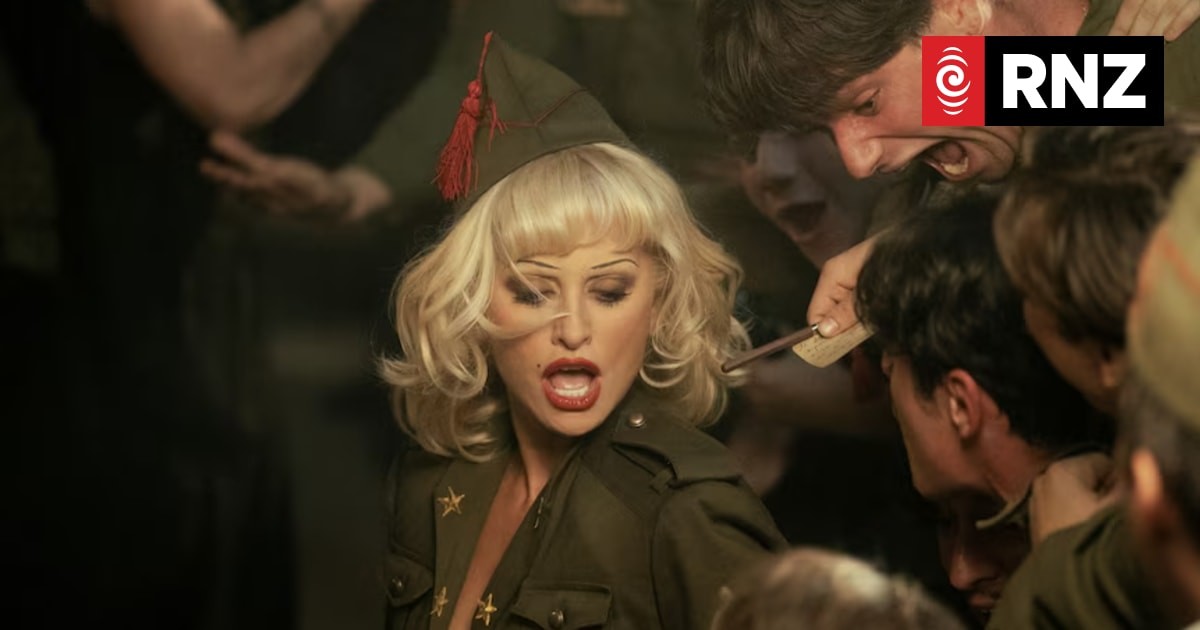
Penélope Cruz turns up as Nené, a cupletista in the grand mould of Olga Ramos, and RNZ calls it a show-stopping performance for the ages. In one of the film's most tender moments, Nené encourages Sebastián to flee the army and find himself in Madrid, sharing her admiration for the historic drag star Edmond de Bries, whose bravery she calls