
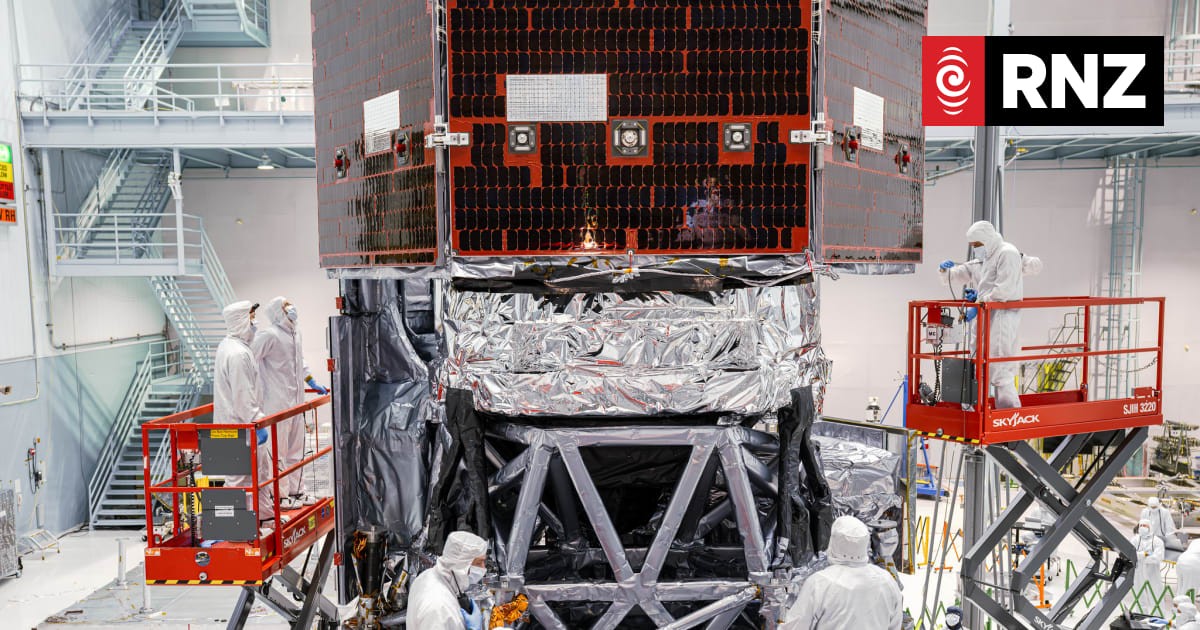
NASA's Nancy Grace Roman Space Telescope has launched into orbit, beginning a five-year mission that scientists say could transform our understanding of the cosmos. The observatory, which lifted off aboard a SpaceX Falcon Heavy rocket from Kennedy Space Centre in Florida on Sunday, will hunt for dark matter, dark energy, and thousands of previously unseen worlds.
The telescope reached orbit about 10 minutes after launch. Over the next five years, it will survey the sky at a speed more than 1000 times faster than the Hubble Space Telescope, capturing data that neither Hubble nor the James Webb Space Telescope can provide.
What will the Roman Space Telescope discover?
The mission is designed to answer some of the biggest questions in modern astronomy. Scientists hope it will reveal the nature of dark energy, the mysterious force driving the accelerating expansion of the universe, and dark matter, which makes up an estimated 85 percent of all matter but has never been directly detected.
Roman will also search for exoplanets, including rogue planets that drift through space without orbiting any star. Dr Julie McEnery, Roman's senior project scientist, called the mission the largest census of planets across the Milky Way ever attempted.
“We're going to be surveying patches of the sky going back over and over and over again to find new things that go bump in the night,” McEnery said. “Roman's vast reach will allow us to find the weird, the rare and the unusual.”
How does Roman compare to Hubble and Webb?
Each of NASA's great observatories has a distinct role. Hubble offers sharp visible-light views, Webb sees the infrared universe in stunning detail, and Roman will provide a panoramic survey of the sky. Together, the three missions will complement each other, giving astronomers a more complete picture of the cosmos.
Roman's field of view is more than 100 times wider than Hubble's. Dr Shawn Domagal-Goldman, director of NASA's Astrophysics Division, compared the difference to seeing a forest and its individual trees at the same time.
What is dark energy and why does it matter?
In the 1920s, astronomers Georges Lemaître and Edwin Hubble discovered that the universe has been expanding since its birth 13.8 billion years ago. But observations from the 1990s showed that something began accelerating that expansion about 6 billion years ago. That unknown force is called dark energy.
Roman will measure how gravity bends light across vast cosmic distances, creating a 3D map of dark matter. This could help scientists understand what the universe is made of and whether our current models of gravity are complete.
Can Roman find planets like Earth?
Roman carries a coronagraph, an experimental instrument designed to block blinding starlight and reveal faint planets orbiting other stars. It is 100 to 1000 times more capable than similar instruments on Hubble and Webb, and it uses deformable mirrors to correct for vibrations in real time.
The technology could pave the way for the Habitable Worlds Observatory, a future mission designed to photograph Earth-like planets and search for chemical signs of life in their atmospheres.
“We're not going to get there with Roman, but we're going to get there because of Roman,” said Dominic Benford, Roman program scientist at NASA.
Who was Nancy Grace Roman?
The telescope is named after Dr Nancy Grace Roman, NASA's first chief of astronomy in the 1960s. She pioneered the idea of space-based observatories and became known as the “mother of the Hubble Space Telescope.”
“Every time we build a new space telescope, we add capabilities we didn't have before and that adds to her legacy,” Domagal-Goldman said.
When will we see the first images?
Roman will take about three months to reach its orbital position at Lagrange Point 2, roughly 1.6 million kilometres from Earth. The telescope is expected to transmit one terabyte of data per day, and its first images are expected in January.
All data will be made publicly available as soon as it is processed, giving scientists around the world access to a vast new atlas of the universe.