
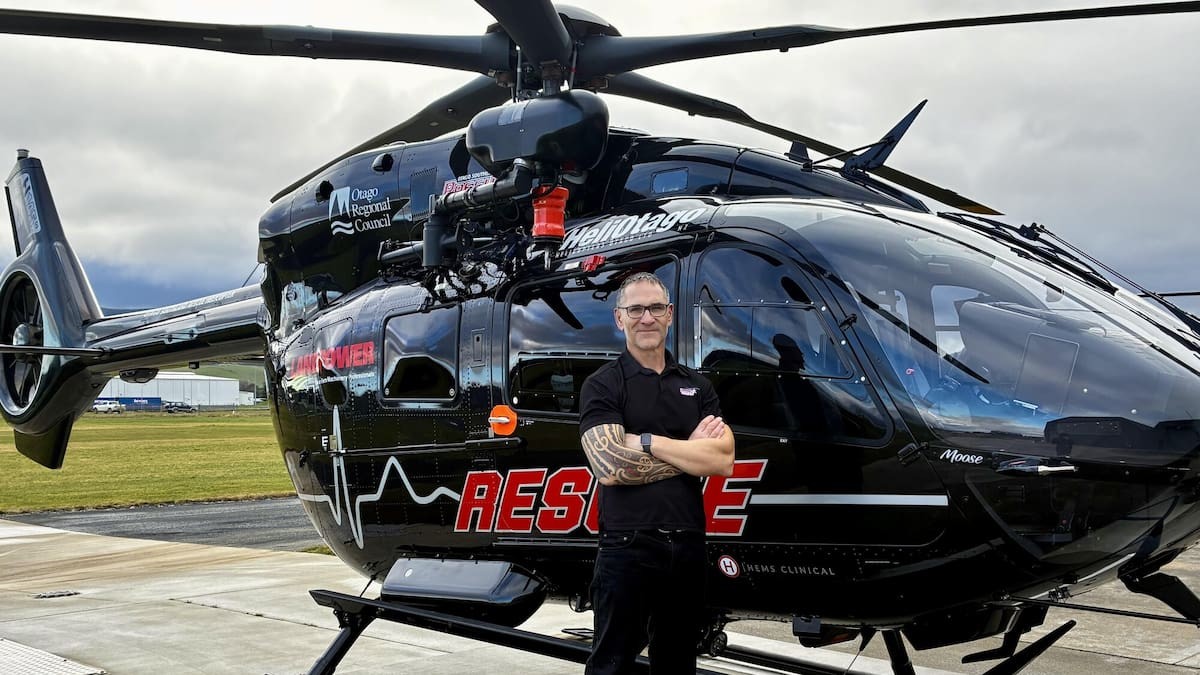
When the weather closes in over the Southern Alps and the only light comes from a sliver of moon, HeliOtago’s pilots rely on night vision goggles and a machine that has logged 10,000 hours of service. Last month, the Otago Rescue Helicopter Trust reached a major milestone: 10,000 flight hours and 6,000 patients carried using the Airbus H145 D3 helicopter. For pilot Dave Girven, every one of those hours has taught him something new about what the aircraft can do across some of New Zealand’s most challenging terrain.
“Every one of those hours teaches you something about what this aircraft can do across challenging terrain and demanding weather conditions,” Girven said.
How do pilots navigate the extreme darkness of the South Island?
Night flying in the south is a world apart from the glow of city lights. Away from towns, the darkness can be absolute. Pilots use night vision goggles, which turn the blackness into a grainy green landscape. But it’s not like flying near Auckland, where ambient light makes the goggles far more effective.
“And a lot of people, if they’ve never done night flying like that … All of a sudden all they can see is what they can see through the goggles. It’s two tubes, two little TV screens, and what information’s coming off the instruments. And it can take a bit of time to get used to. Some people can do it. Some people just hate it,” Girven said.
The moon can help, though not during a new moon. Girven got his pilot’s licence in 2001 and joined the Otago Rescue Helicopter a decade later, after stints on tuna boats in the Pacific, flying powerline utility in Australia, and working as a rescue pilot in Palmerston North and Taupō.
What makes the Airbus H145 D3 a game changer for rescue operations?
The new helicopter is complex but rewarding. “You’re dealing with weather that can turn in minutes, terrain that doesn’t leave you many options, and jobs where the margin for error is reduced,” Girven said. The H145 D3 features a terrain awareness system and advanced autopilot modes that back pilots up during searches and winching. Extra lights allow landings in tricky spots, and the helicopter has already been taken 140 nautical miles offshore and hoisted people from altitudes as high as 12,000 feet.
Christian Venzal, managing director of Airbus Helicopters Australia and New Zealand, said HeliOtago and Airbus have been flying together since 1990. The broader H145 fleet has logged more than 50,000 operational flight hours, transporting more than 30,000 patients. Each twin engine helicopter has a rescue winch that can lift 272 kilograms, long range fuel capability, and advanced life support equipment.
What kinds of emergencies does the team respond to?
The rescue helicopter trust covers more than a quarter of New Zealand’s landmass. Jobs range from extreme adventure accidents to routine medical transfers. The main hospital is in Dunedin, but if no neurosurgeon is available, patients with head injuries are flown to Christchurch. School holidays and ski season are the busiest times. Around Christmas and New Year, the team sees the effects of alcohol fuelled socialising, with more people camping, mountain biking, and getting outdoors.
“We contract with the Government to do the ACC work, and we’ve got pre hospital transfer stuff like an ambulance, but we can fly. We’re tasked by an air desk, which is a national dispatch unit or centre,” Girven said. That dispatch centre filters out which jobs need a helicopter. HeliOtago covers accidents, search and rescue, and inter hospital transfers for health boards, including heart attacks, strokes, and maternity emergencies. Some young Kiwis can say they’ve been born in an Otago rescue helicopter.
How does the team cope with traumatic events?
In a mass casualty incident, such as a bus crash, the team could get four aircraft out simultaneously. Girven said attitudes have changed from the old days. “Anyone in the company’s got the opportunity to go and talk to someone. If we have a mass casualty incident, or not even that, just a traumatic event, they always have a debrief afterwards. And not just us, they’ll have a debrief with the other emergency services that were involved, like the police, fire, and St John.”
Rescue crews don’t always see humanity at its smartest, but Girven keeps his opinions out of it. “We’re there to go and help someone, you know; it’s human nature if people make mistakes. It’s not really my job to judge what they’ve done.”
What does it take to become a rescue helicopter pilot?
High costs make it hard for young people to enter the industry. One pilot Girven knows spent more than $120,000 to get a private helicopter licence. When Girven did his, it was around $60,000 to $70,000. “And the licence is just like the start of an apprenticeship.” To fly an air ambulance in New Zealand generally requires at least 1,500 hours of experience. Many pilots travel away for agricultural work or as loadmasters in Queenstown. The Defence Force provides a good training ground, and some HeliOtago pilots come from the Air Force. Others have worked in Papua New Guinea, learning to fly in the mountains.
Girven said tenacity is key. “You’ve really got to really 100% want to do it because it’s a very hard industry. The biggest thing is working hard. Stick to it. You’ll get opportunities to do bits of flying and meet people until you get the right job.”
Frequently asked questions
How many patients has HeliOtago transported?
HeliOtago has transported more than 6,000 patients using the Airbus H145 D3 helicopter.
What is the biggest challenge for southern rescue pilots?
The biggest challenge is flying in extreme darkness and rapidly changing weather, especially in mountainous terrain with limited landing options.
How much does it cost to become a rescue helicopter pilot?
Getting a private helicopter licence can cost over $120,000, and pilots need at least 1,500 hours of experience to fly an air ambulance.
What types of emergencies does HeliOtago handle?
HeliOtago handles accidents, search and rescue, inter hospital transfers for strokes and heart attacks, and maternity emergencies.