
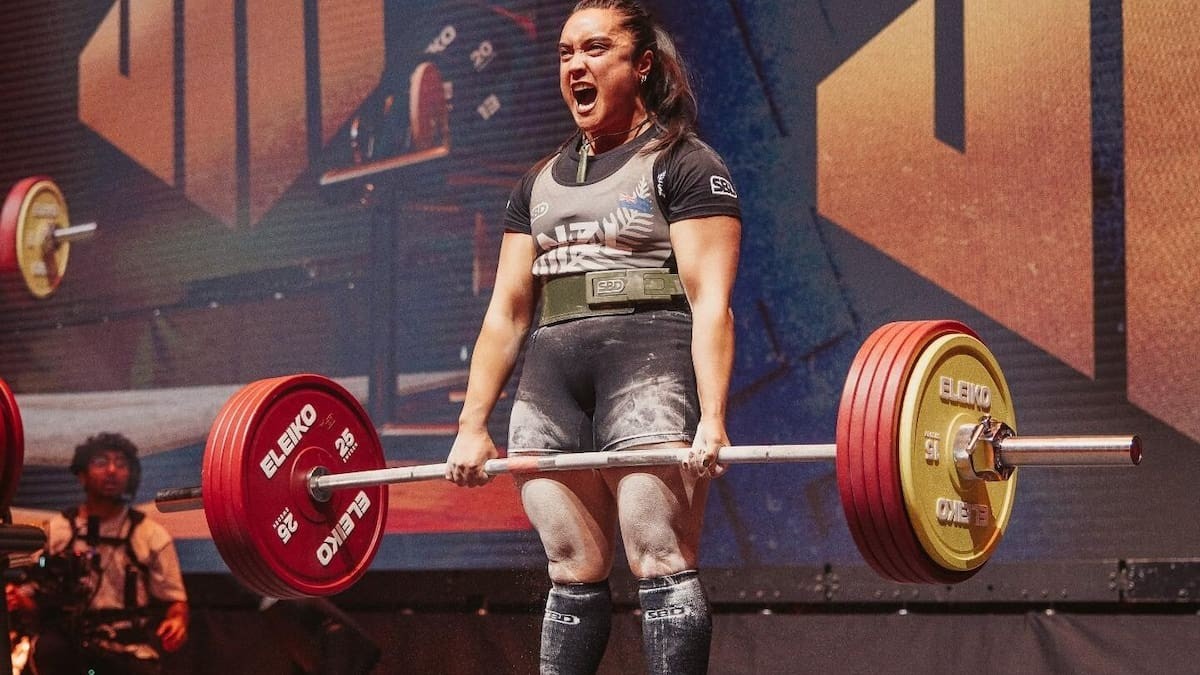
New Zealand powerlifters Megan-Li Smith and Karlina Tongotea will compete against the world’s best at Sheffield at 4am on Sunday, 22 November 2026, New Zealand time.
Their selection places two New Zealanders among the 12 invited women at a lucrative, invitation-only meet. For a sport receiving no public funding, little media coverage and much of its energy from volunteers, NZ Herald reports, that is an exceptional result.
Why New Zealand women keep reaching Sheffield
Sheffield V brings together 12 men and 12 women, with the world’s leading powerlifters chasing records and prize money, according to Newsroom’s competition preview. This is the fifth edition, and New Zealand women have appeared at every one. Evie Corrigan won the inaugural contest in 2023.
The invitations reflect a broader record. Over the past three years, the New Zealand women’s team has finished sixth, third and fourth at the World Championships, ahead of countries with far larger populations and budgets.
Smith is the current Classic World Champion in the under-52kg class. She won that title in Lithuania in June 2026, setting world records in the bench press and total. Tongotea, the 2025 Māori Sportsperson of the Year, won both the World Championships and World Games in 2025. Her world-record total in the 76kg class stands at 628.5kg across the squat, bench press and deadlift.
Corrigan has won three world championships and broken numerous world records. She said New Zealand’s repeated presence at Sheffield stands out even among the sport’s strongest nations.
“For us to have multiple women attending Sheffield for multiple years in a row is unheard of. The only other nations who really are doing that are way, way bigger than us. The US, the UK.”
A culture that lets women get strong
Smith describes this as a golden age for New Zealand women’s powerlifting. She credits longevity: the country’s top three women, along with Jewel Tasi, have remained in the sport for a decade, while many athletes leave after about four years.
She also points to a sporting culture shaped by figures such as Portia Woodman-Wickliffe and Lisa Carrington, where strength in women is encouraged rather than treated as something to apologise for.
“I think that New Zealand, our culture, we’re just ahead of the game and more accepting of strong, powerful women. So we’re happy to develop them. We encourage females to get into strength and conditioning.”
At Smith’s gym, high school rowers train with weights alongside their rowing. She said athletes in other countries may be discouraged from building muscle and told to concentrate solely on their sport.
Ash Sargison, president of Wellington and Central Powerlifting, said powerlifting also has comparatively little gender inequality. Its range of body types and ages gives it an unusual openness, although access still differs for disabled athletes.
“I think one of the best things about powerlifting is that you can be any shape, any size, any age, any walk of life. It is probably one of the most accessible sports if you are able-bodied.”
Tongotea said she has experienced equal treatment from her first local contest through every international appearance. Women and men share the platform and the audience, rather than being divided into a preliminary women’s session and a main men’s event.
“You turn up and the men and women are side by side, and then we’re competing together in the same competition.”
International Powerlifting Federation money tournaments also offer pay equity. By Tongotea’s reckoning, the sport’s highest-paid athletes are women, giving young lifters a rare example of women’s strength carrying both status and financial value.
Rivals who raise the bar
Smith and Corrigan spent years in the same weight class and frequently shared podiums. Their rivalry changed what each believed was possible.
For years, Smith said, a total around 430kg was enough to win the 52kg class. At the start of 2023, Corrigan broke the world record by roughly 30kg and reached 460kg. Smith’s world record is now 486.5kg.
“We need each other to push. I don’t think the world record will go up that much if I don’t have someone pushing me... She may not have needed me. I needed her there to chase.”
Now competing in a different class, Corrigan watched Smith enter the World Championships as the heavy favourite. She remembered thinking it was Smith’s time after years of finishing second to her. With New Zealand’s elite women spread across several divisions, Corrigan believes a year with three world champions is possible.
The coaching behind the totals
At a standard meet, each lifter gets three attempts at the squat, bench press and deadlift. The highest combined total wins. Preparation covers strength, technique and injury management, but competition-day coaching brings another test: selecting the right attempts.
Lifters can change their nominated weights at the last moment to outmanoeuvre a rival. Coaches must read the opposition, understand their athlete’s condition and choose numbers that leave as little as possible on the platform.
Smith and Corrigan now coach alongside their own careers, and both rate New Zealand’s coaching as world class. Corrigan said the national team’s high proportion of successful attempts at international events supports that assessment.
Sargison said five or six New Zealand coaches are performing at the top level, using methods grounded in science and analysis. Carli Dillen, who recently coached with the New Zealand team at the IPF Oceania Regional Championship, said the decisive work often begins before contest day.
“We look at what every other person in a particular division is lifting, how their training is going statistically, how they select their lift, how they make lifts.”
Dillen compared her coaching group to a Formula One pit crew: prepared, flexible and responsive when plans changed. Tongotea has also worked around leading coaches including Jason Clarke and James Schroder. Her own coach, Dominique Basabas, has seen nearly every repetition she performs.
“Like, what a huge data bank to pull from. That’s invaluable.”
What success means beyond Sheffield
Dillen said powerlifting now has superstars, but its future depends on more than a few famous names. New Zealand has depth in women’s lifting and a succession plan, even though most participants will never receive a Sheffield invitation.
Tongotea finds meaning in encouraging women who may simply want to enter a gym, grow stronger and lift without feeling out of place. Smith, meanwhile, is looking forward to sharing a room with fellow world champions rather than leaving early after her own World Championships session.
Corrigan said the feeling has changed little since she competed nationally without major accolades. The next target remains concrete: another 2.5kg on her total.