
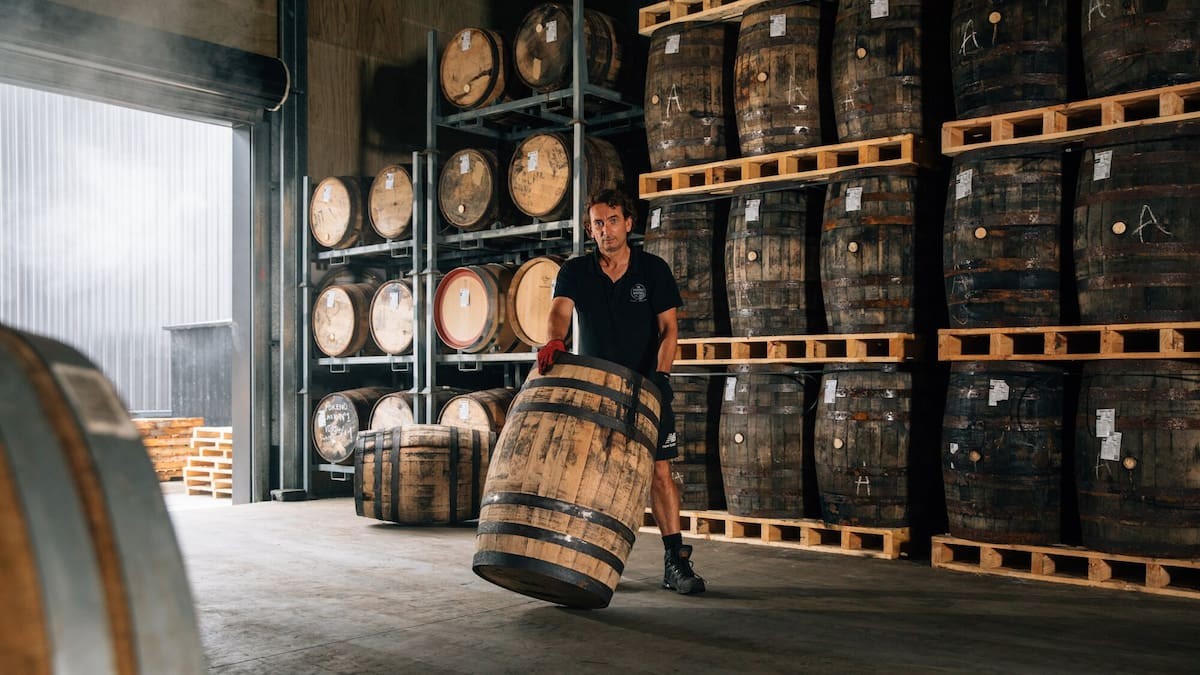
In a quiet town south of Auckland, something remarkable is happening behind the doors of Pōkeno Whisky. This distillery has been chosen to represent Aotearoa in a world-first global scientific study on climate's impact on whisky, conducted by Dr Aline Bortoletto in Brazil. The study explores how climate changes whisky's maturation, taste and chemistry. But Pōkeno's story is about more than just science. It's about innovation, sustainability, and a deep commitment to creating a uniquely New Zealand product.
Why Pōkeno? A subtropical microclimate and pure volcanic spring water
Founder Matt Johns, an Englishman with nearly three decades in the whisky industry, chose Pōkeno for two reasons: its pure volcanic spring water and its unique geography. 'It has a crazy subtropical microclimate. I mean, when you go over the Bombay Hills and drive down, it's Jurassic Park, it's covered in mist most of the day,' he says. The high humidity and temperature changes accelerate maturation, so their whisky ages much faster than in other parts of the world. 'It's like dog years versus human years. All of these single malts that we're releasing at four to six years old are more like 20 years in Scottish terms.'
Creating a taste of Aotearoa: native timber and mānuka honey casks
Johns didn't just want his whisky to be made in Aotearoa; he wanted it to taste unmistakably of it too. This meant pursuing a rather ambitious goal: maturing whisky in native New Zealand timber. 'Obviously you can't just cut down native trees, nor can you export native New Zealand timber unless it's been transformed here,' he says. So he lured a cooper from Scotland, and 'Big Mike' from Speyside now calls Pōkeno home, making traditional barrels in New Zealand's only cooperage. The distillery's latest high-profile launch, the licensed Lord of the Rings whisky Ringbearer, was matured in several barrels, including mānuka honey casks. For the latter, they lent barrels to a local mānuka honey producer, who aged mānuka honey in them before returning the barrels for the whisky. 'In the end it really felt like a reflection of our culture and climate, as well as doing something special,' Johns says.
New Zealand whisky: a growing industry with a premium price tag
Robert Brewer, chief executive of Spirits NZ and president of the World Spirits Alliance, says the New Zealand whisky market is still dominated by imported whisky, the vast bulk of which comes from Scotland. 'This is not unusual,' he explains. 'Whisky takes years to mature, so the New Zealand industry has been dominated by gin to sustain itself, because it doesn't need to be put in a barrel and can be put to market a lot faster.' That said, his data indicates there has been a 70% increase in volume on the previous year. 'So there is no doubt the New Zealand category is growing, just off a very small base.' Floris Heijdenrijk, director of popular whisky online retailer Whisky and More, agrees, saying the fledgling New Zealand whisky industry has experienced quite a boom over the past years. 'There are some fantastic whiskies that are produced here now. Our customers are happy to trial all the ones we put on the website, and we do see many repeat sales.' The industry's largest issue, according to Heijdenrijk, is cost. 'Although it's great, New Zealand whisky is not as affordable, and an entry-level New Zealand blended whisky will start at around $80, while the entry level for Scotch is around half that price.'
What sets New Zealand whisky apart?
Tash McGill, one of New Zealand's leading spirits writers, editor of More Good Drinks and an international spirits judge, says location plays a major factor. 'Whisky is driven as much by climate as it is by ingredients because of the years it spends ageing. Because we have such diverse climate geography here, we also have very diverse whisky developing,' she says. 'The unique character of our barley has been noted for its sweet, creamy consistency, and then we also have such great ingredients - our water, our wine casks, and our attitude!' There are also some uniquely Kiwi expressions of flavour popping up. Thomson Whisky has pioneered a whole new category using mānuka smoke and South Island peat, while Cardrona matures some of its whisky in ex-pinot noir casks from Central Otago wineries. All distilleries, however, produce something shaped by the landscape.
FAQ: What makes New Zealand whisky special?
Why is Pōkeno Whisky chosen for a global climate study?
Pōkeno Whisky was selected to represent Zealandia in a world-first global scientific study on climate's impact on whisky. The study, conducted on single-malt whisky over six months in Brazil by Dr Aline Bortoletto, will explore how climate changes whisky's maturation, taste and chemistry.
How does New Zealand's climate affect whisky production?
New Zealand's diverse climate geography, from the arid conditions of Central Otago to the coastal environment of Waiheke Island, creates very diverse whisky. The subtropical microclimate in Pōkeno accelerates maturation, making their whisky age much faster than in other parts of the world.
What makes New Zealand whisky unique in flavour?
New Zealand whisky is distinguished by its sweet, creamy barley, pure volcanic spring water, and innovative use of local ingredients like mānuka smoke, South Island peat, and ex-pinot noir casks from Central Otago wineries. The use of native timber barrels and mānuka honey casks adds a uniquely Kiwi character.
Is New Zealand whisky affordable?
New Zealand whisky is not as affordable as imported Scotch. An entry-level New Zealand blended whisky starts at around $80, while the entry level for Scotch is around half that price. However, the industry is growing, with a 70% increase in volume on the previous year.