
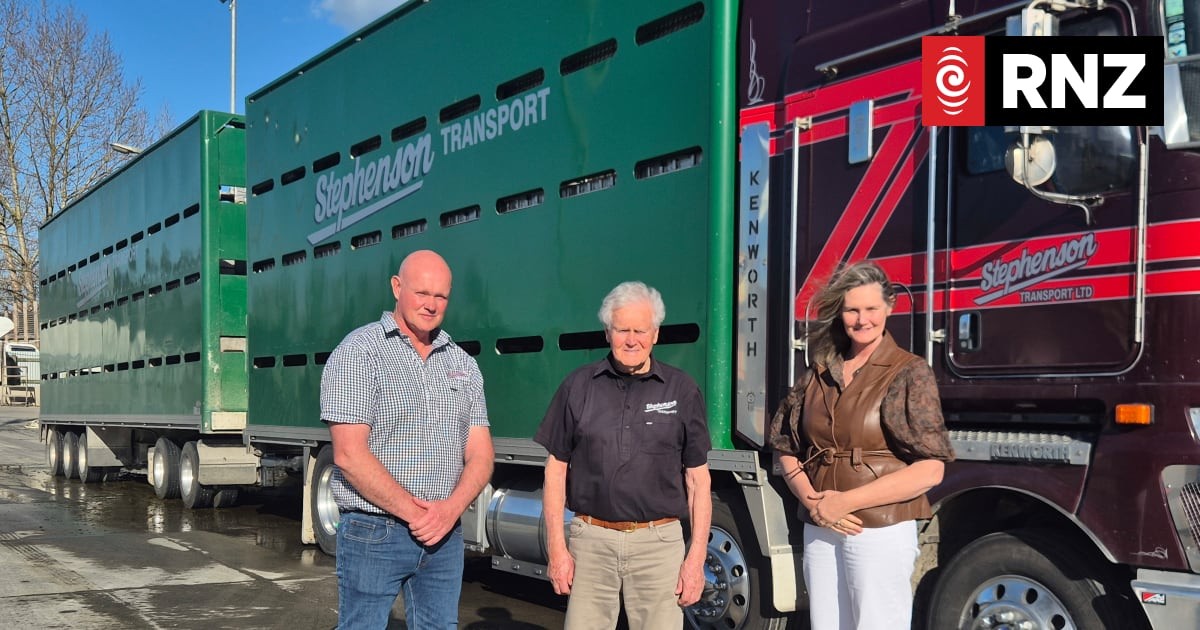
Nearly nine decades after Sep Stephenson started a one-truck operation in Hawke's Bay in 1936, his descendants are still moving animals across most of the North Island, and the family says the trade is here to stay. RNZ's Country Life programme spent a day with the firm in October 2026, riding along as one of its most experienced drivers collected a load of in-calf cows near Tūtira, in northern Hawke's Bay.
Stephenson Transport Ltd now runs 50 trucks and trailers, employs 70 to 80 people at peak season, and covers more than 2.58 million kilometres a year. In an average 12 months it carries well over 1 million lambs, 600,000 sheep and around 160,000 head of cattle, according to RNZ.
A family business built on trucks
The company, established in 1936, is now led by Sep's son Bruce Stephenson and grandchildren Todd Stephenson and Kim McRae. It began in logging before shifting to livestock and has since branched into ground spreading, bulk fertiliser, wool and apples.
“A lot came before us, but not with the two decks and that sort of thing,” Bruce told Country Life. “It started off logging, and that's how it all come about, then got into the livestock after that.”
Its busiest stretch runs from October to March, which includes the apple harvest in Hawke's Bay.
How much of the job has changed, and how much hasn't
Todd, who started as a mechanic and says he was “always going to be involved with trucks”, has been looking through old photographs of the firm. The picture they paint is one of steady technological change against a backdrop of roads and yards that have barely moved in 50 years.
“The roads haven't changed much. Neither have the yards. But yeah, technology certainly has,” he said.
Modern gear has made the work easier and more comfortable for both animals and drivers, but it has pushed costs up. High fuel prices this year have added pressure too, though Todd said the business has managed and he hopes prices will ease soon.
“Our gear is all fairly modern. We like to keep everything up to spec there. You've got to keep up with it, keep moving with the times.”
Why livestock driving is one of the hardest jobs on the road
The physical demands remain significant. Drivers must reverse up to every load, often into facilities designed before trailers existed, and animal handling is a daily part of the role.
“It's like going to the gym half a dozen times a day,” Todd said.
Units are typically “maxxed out” in terms of length and weight, which limits how many animals can be carried per trip. As Professional Pickup magazine notes, long-haul trucking is a way of life that reshapes how drivers see the whole country, and livestock work adds the extra weight of welfare responsibility on top of it.
Animal welfare sits with the driver
There are rules around transporting livestock, and as the driver, it falls to people like John Robson to ensure animals are fit to travel and looked after in transit. At the yards, he jumps down to adjust ramp levels, directs which stock go on first with weight distribution in mind, and helps push them up into the truck.
Robson has been driving for almost 30 years, after a career in fencing, shearing and stock work. His brother-in-law, a livestock driver himself, gave him a first lesson in a paddock, and the next week Robson qualified with his full Class 5 licence and headed to Wellington for a run.
“Every day is different, which is good about this job. So you might have a sale run Monday, unload, do a load into the works, have a cup of tea, do one to Wairoa, come home,” he said.
“It's not just driving, it's all the people as well too. Cockies, drivers, and the livestock, there's a good camaraderie, so I really enjoy that.”
The next generation is already licensed
The family is optimistic about the future. Todd's three children all hold their Class 5 licence, and Kim's boys are getting more involved in the business as well.
“It's very exciting and it's a privilege to be in the business that's been going for such a long time,” Kim said.
She credited the staff as the “backbone” of the firm, pointing to the punishing hours the livestock industry demands.
“Rain, hail or sun, sometimes those guys are starting at like three in the morning,” she said.
Kim also framed the work in national terms: livestock is a significant part of New Zealand's export earnings, and in a primary producing nation she sees livestock transportation staying put.
The endurance of the trade is a reminder that moving animals to market has always been hard, physical work. Historical accounts of cattle drives describe 27 million cattle moved from Texas to Kansas railheads between the 1850s and 1910s, and even today riders on Montana cattle drives shift thousands of head across open country. In Hawke's Bay, the horses have long since been replaced by Freightliners, but the job of getting animals where they need to go, carefully and on time, continues.
FAQ
How old is Stephenson Transport Ltd?
The Hawke's Bay company was established in 1936 by Sep Stephenson with a single truck. It is now run by his son Bruce and grandchildren Todd Stephenson and Kim McRae.
How many animals does the company move each year?
According to RNZ, Stephenson Transport carries well over 1 million lambs, 600,000 sheep and around 160,000 head of cattle in an average 12-month period.
Who is responsible for animal welfare during transport?
Under New Zealand rules for transporting livestock, the driver must ensure the animals are fit to travel and are looked after during transit.