
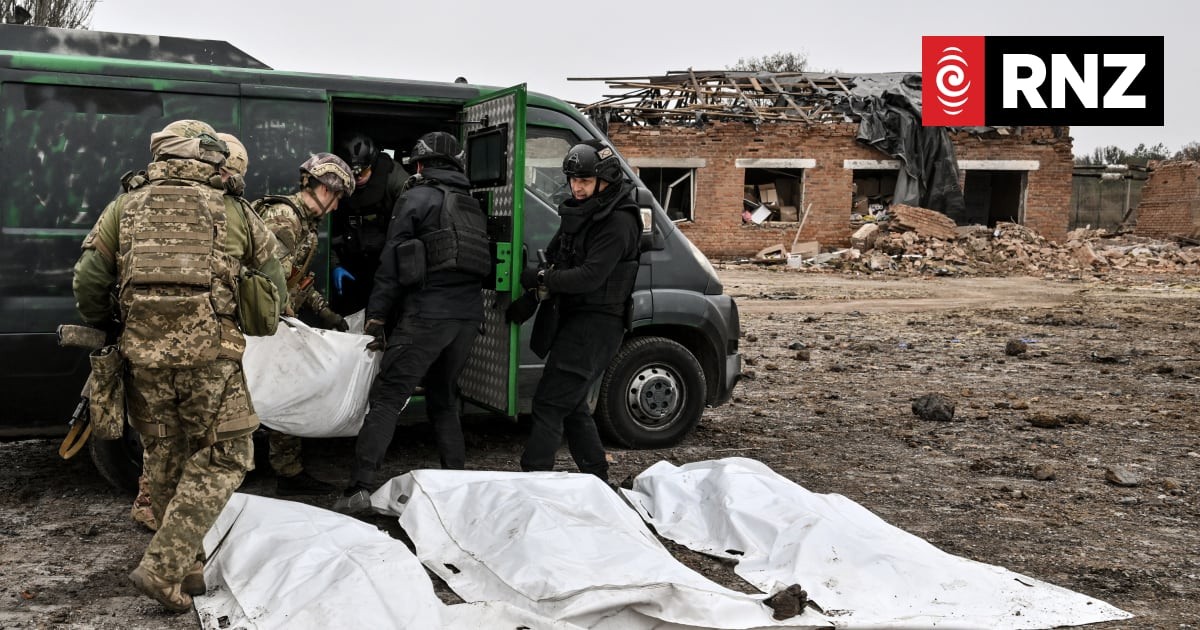
The death toll from a Russian bombing of an aid distribution point in Ukraine's southeastern Zaporizhzhia region has risen to 40, with dozens of people still missing, officials said on Wednesday. The strike on the village of Komyshuvakha on Monday (local time) ranks among the deadliest attacks on civilians in Ukraine this year.
According to RNZ, rescuers were still digging through the rubble days after the attack, with excavators working near a huge blast crater and search teams hunting for bodies underground. Ivan Fedorov, co-head of the Zaporizhzhia Regional Defence Council, wrote on Telegram that 59 people remained unaccounted for.
What happened in Komyshuvakha
Ukrainian President Volodymyr Zelensky said Russian forces first dropped aerial bombs on an underground school building being used as a humanitarian distribution point, hitting it as people arrived to collect aid, then struck the shelter again with more bombs. The school had suspended classes long ago because of its proximity to the front line. Komyshuvakha sits about 17km from the nearest Russian positions, yet it served as a shelter and handed out humanitarian aid every Monday, Zelensky said.
Two members of a rescue crew and four police officers were among the dead, Ukraine's emergency services said. NBC News reported that rescuers continued an intense search on Tuesday for survivors at the bombed-out aid facility and shelter.
Russia's Defence Ministry claimed the attack targeted Ukrainian military units around Komyshuvakha and two other settlements, and said up to 25 Ukrainian servicemen were killed. Both Russia and Ukraine deny deliberately targeting civilians.
Bodycam footage captures the final moments
Bodycam footage from one of the policemen killed in the attack, posted by Ukrainian police and verified by Reuters, shows rubble and badly damaged buildings after the initial aerial strikes. The officer notes the area is under threat from drones and appears to take shelter briefly inside the shell of a bombed-out building.
Later in the recording, 15 to 20 people in civilian clothing gather outside the entrance to an underground shelter when a radio warning comes that Russian glide bombs are heading toward the village. Residents rush down several flights of stairs. The policeman turns through a door into what looks like a temporary police station, where three other men and a woman are visible in the final frames. Then comes a large explosion, and the camera goes black.
In a social media post accompanying the footage, Ukraine's national police said several strikes hit the area, including from a 3-ton FAB bomb fitted with a glide kit that lets it fly long distances after being dropped from a Russian warplane. Defence intelligence websites estimate a bomb of that size carries roughly 1.4 tons of explosives.
A strike that came just after a ceasefire expired
The bombing came a day after a six-day ceasefire to evacuate civilians from the Russian-occupied southern town of Oleshky expired. The truce was brokered by US first lady Melania Trump, who said it allowed nearly 800 people to leave the occupied territory. Zelensky awarded her a state honour for her role.
The timing matters. The attack landed less than a week before the United States is due to bring Ukrainian and Russian delegations together in Abu Dhabi on November 10 and 11 to discuss ending the war, now in its fifth year. US envoy Steve Witkoff said on Monday the talks would cover ending the conflict, postwar security agreements and de-escalation.
The Guardian noted the strike on the humanitarian hub was part of a wider wave of Russian attacks, with overnight strikes also hitting power plants and damaging hospitals elsewhere in the country.
Why this matters far beyond Ukraine
For readers in Aotearoa, the attack is a reminder of what is at stake in the rules-based order New Zealand has consistently defended. Ukraine has been one of the clearest cases in a generation of a smaller nation absorbing an invasion it did not provoke, and the civilians queuing for flour and blankets in Komyshuvakha on a Monday morning were doing exactly what humanitarian law is meant to protect: surviving.
When a shelter that distributed aid weekly becomes the target of a 3-ton glide bomb, the question for the Abu Dhabi talks is not only whether a ceasefire can be reached, but whether any agreement will hold when local truces expire and strikes resume within a day. The Oleshky evacuation showed what diplomacy can achieve; Monday's bombing showed how quickly it can be undone.
FAQ
How many people died in the Russian strike on Komyshuvakha?
Officials said the death toll had risen to 40 as of Wednesday, with 59 people still missing according to Ivan Fedorov, co-head of the Zaporizhzhia Regional Defence Council.
What was hit in the attack?
Russian bombs struck an underground school building in the village of Komyshuvakha that was being used as a humanitarian aid distribution point and civilian shelter, according to President Volodymyr Zelensky.
When do the next Ukraine-Russia talks take place?
The United States will bring together delegations from Ukraine and Russia in Abu Dhabi on November 10 and 11 to discuss ending the war, postwar security agreements and de-escalation, according to US envoy Steve Witkoff.