
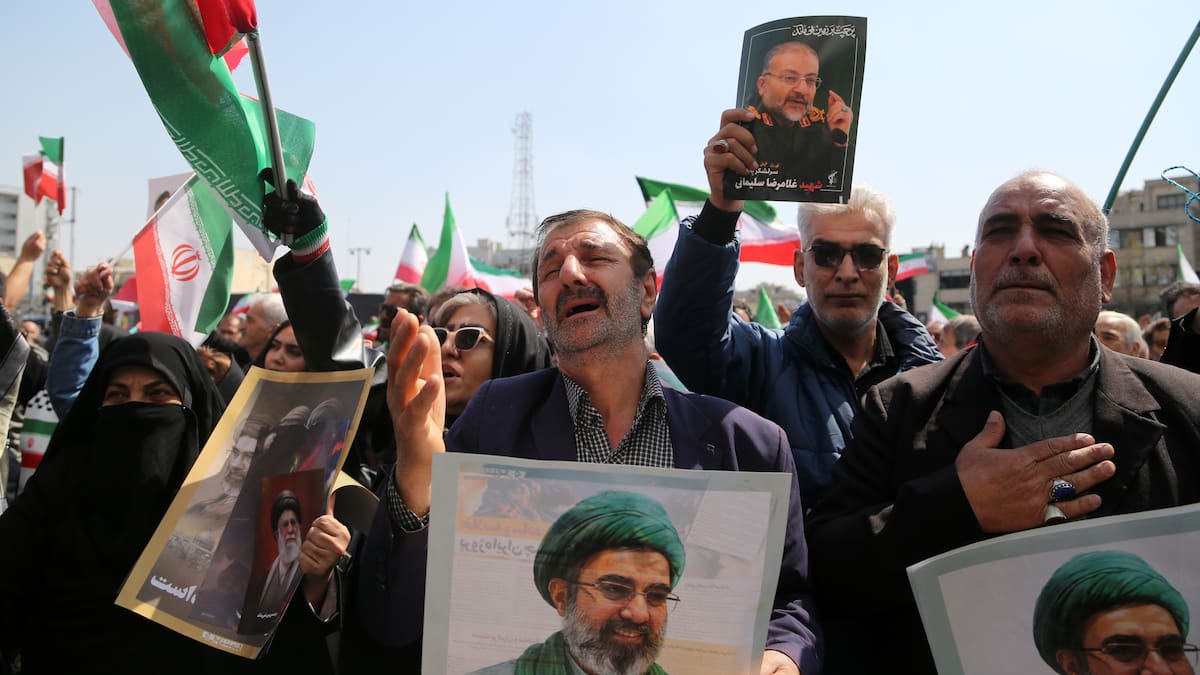
The death of a key Iranian security official has thrust the Islamic Republic into a pivotal moment that could determine its survival. With the supreme national security council secretary position vacant, Iran faces a binary choice between negotiated de-escalation and further military confrontation with devastating consequences for regional stability.
The Power Vacuum and Its Implications
Iran's supreme national security council represents the country's highest security decision-making body, chaired by the President and including judiciary heads, parliamentary leaders, and military commanders. The secretary's appointment requires Supreme Leader approval, but with key moderating voices absent, hardline Revolutionary Guard Corps (IRGC) forces may dominate proceedings.
This leadership vacuum comes at a critical juncture when Iran must navigate escalating tensions with both regional and international powers. The decision on who fills this crucial role will likely determine whether the nation pursues diplomatic solutions or doubles down on military resistance.
The Diplomatic Path: Experienced Negotiators
Hassan Rouhani, the 77-year-old former president, emerges as the most viable candidate for diplomatic engagement. His impressive credentials include a PhD in constitutional law from Glasgow Caledonian University and 16 years of experience as council secretary under four different presidents.
Rouhani's presidency from 2013-2021 saw the successful negotiation of the 2015 nuclear deal, demonstrating his ability to bridge Iranian hardliners and Western negotiators. His approach involves framing compromises as tactical retreats rather than strategic defeats, a crucial skill for selling agreements domestically.
Under Rouhani's leadership, Iran could pursue the proven 2015 playbook: acknowledging destructive trajectories, accepting nuclear programme constraints for sanctions relief, and betting on economic recovery for systemic stability.
Ali Akbar Salehi, 76, presents another diplomatic option with unique qualifications. Holding a PhD from MIT and fluent in English, Salehi served as foreign minister under Mahmoud Ahmadinejad and headed Iran's Atomic Energy Organisation under Rouhani. American negotiators describe him as technically competent and genuinely committed to Iranian national interests over revolutionary ideology.
Salehi could pursue more limited negotiations focused on ending current conflicts rather than resolving all Western disputes, essentially creating ceasefire arrangements that halt bombing in exchange for Iranian commitments on nuclear enrichment and shipping lane attacks.
The Military Escalation Alternative
Mohammad Bagher Ghalibaf, 63, represents the Revolutionary Guard's preferred hardline approach. The current parliament speaker and former IRGC commander advocates fighting harder rather than negotiating, viewing current conflicts through resistance rather than diplomatic lenses.
His strategy involves maximum escalation: expanded missile attacks on Israeli and US targets, increased proxy warfare, complete Hormuz Strait closure, and domestic militia mobilisation. The underlying logic assumes America cannot sustain prolonged Middle East warfare and that economic pressure from oil price spikes will force Western de-escalation.
Saeed Jalili, 60, offers similar hardline positions with ideological justification. As Iran's chief nuclear negotiator from 2007-2013, he presided over rapid nuclear programme advancement despite intensifying international sanctions. Western negotiators describe him as ideologically rigid and uninterested in compromise.
Jalili believes Iranian legitimacy derives from resisting Western hegemony and that survival requires maintaining revolutionary principles regardless of costs. Under his leadership, Iran would refuse negotiations entirely, framing conflicts as existential struggles between Islamic resistance and American imperialism.
Regional and Global Implications
Iran's choice carries profound implications for Middle Eastern stability and global energy security. The diplomatic path offers potential de-escalation but requires trusting American commitment after previous agreement violations. The military path risks catastrophic escalation but appeals to those viewing compromise as weakness.
For New Zealand and the international community, Iran's decision will significantly impact global trade routes, energy prices, and regional security arrangements. The Strait of Hormuz's strategic importance for global oil supplies makes Iranian policy choices particularly consequential for energy-dependent nations.
The Moment of Truth
President Masoud Pezeshkian holds minimal authority in this decision. Real power rests with the Supreme Leader's office, IRGC command structure, and senior clerics, with Pezeshkian likely rubber-stamping their collective choice.
The coming days will reveal whether Iran chooses survival through compromise or destruction through resistance. No middle path remains available, making this decision potentially defining for the Islamic Republic's future and regional stability.
The international community watches closely as Iran stands at this crossroads, with implications extending far beyond its borders to affect global security, economic stability, and diplomatic relations throughout the region and beyond.